Tuesday Night Open Thread

Old songs are the best. Now, while I like old songs, I never really got into The Andrews Sisters. Nor really sure why. They just never clicked with me. But they sure had a shipload of hits, including this one, which was the first Number One single of 1945, where it spent seven weeks atop the chart.

[The YouTube]

Technically, it was the second Number One of 1945, as the year began with “Don’t Fence Me In” which the Andrews Sisters and Bing Crosby performed, and which finished 1944 at Number One. So, this song was actually the first new Number One of 1945.

Do you have something you’d like to share? A link? A joke? Some words of wisdom? A topic to discuss? It’s our nightly Open Thread, and you have the floor.


I Sure Would Appreciate It If You Could Find It In Your Heart To Hang These Men By The Neck Until They Were Dead

I own a police scanner.

Please take a look at the first four words of this call from a dispatcher to a patrol unit that I just heard:

Received a 911 call about someone unloading trees at the plant nursery.”

I mean . . .

Maybe it’s not an “essential business” — but isn’t it, to them? Food on the table, if they sell them?

I mean . . .

Is this is what has become of our . . . ?

[cue Charlie Brown at the Christmas Pageant]:

Aaauuuuugh!

Oppo has officially lost it.

… And Speaking of Scientists …

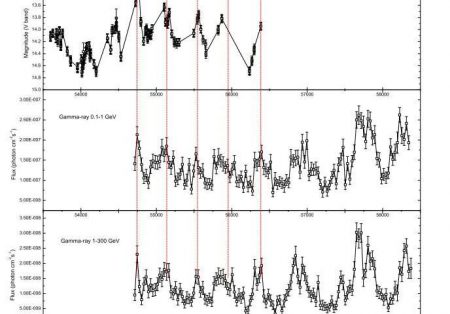
Astronomers Perform Variability Study of the Blazar 3FGL J0449.4-4350

— Which Just Turns Out To Be The “Guitar Hero” Track for the Song “Louie, Louie”

— Tomasz Nowakowski / Phys.org / 4/1/20

The light curves of optical V, 0.1-1.0 GeV, 1-300 GeV band in 30 days bin for 3FGL J0449.4-4350. The vertical dash lines show clearly the similarity of the variations in three light curves to a song with a great beat to which one can dance. Credit: Yang et al., 2020.

Chinese astronomers have conducted a gamma-ray and optical variability analysis of the blazar 3FGL J0449.4-4350. The new research, presented in a paper published March 25 on arXiv.org, reports the detection of possible quasi-periodic oscillation (QPO) from the source and provides more insights into the origin of such behavior. . .

“. . . as will our eventual determination of the exact meaning of the lyrics,” he added, pushing up his glasses.


Straight Line of the Day: Scientists Are Going To Try To “Squeeze Light.” If They Can Do That…

Straight Line of the Day: Scientists are going to “squeeze light”. If they can do that…


To work, the LIGO mirrors need to be isolated from any background vibrations from the ground and nearby instruments. To achieve this, the mirror arrays are suspended by thin threads of glass. The entire system also needs to be placed in a vacuum. The detector is so sensitive that air molecules passing through the light beams are picked up as noise. The air pressure inside LIGO‘s vacuum chamber is less than a trillionth of an atmosphere, which is lower than intergalactic space.

To the limits of human engineering, the LIGO system is an isolated vacuum system where the only thing that can move the mirrors is gravity itself. It isn’t perfect, but it is very good. So good that things start to get weird. Even if the detector was perfectly isolated, and placed in a perfect vacuum, the detectors would still pick up noise. The system is so sensitive that can pick up quantum fluctuations in empty space.