What’s Walrus Building?

Thanks God it’s Friday and welcome all. I know you are keen to see what I am building currently and here it is.

Vickers A1E1 Independent
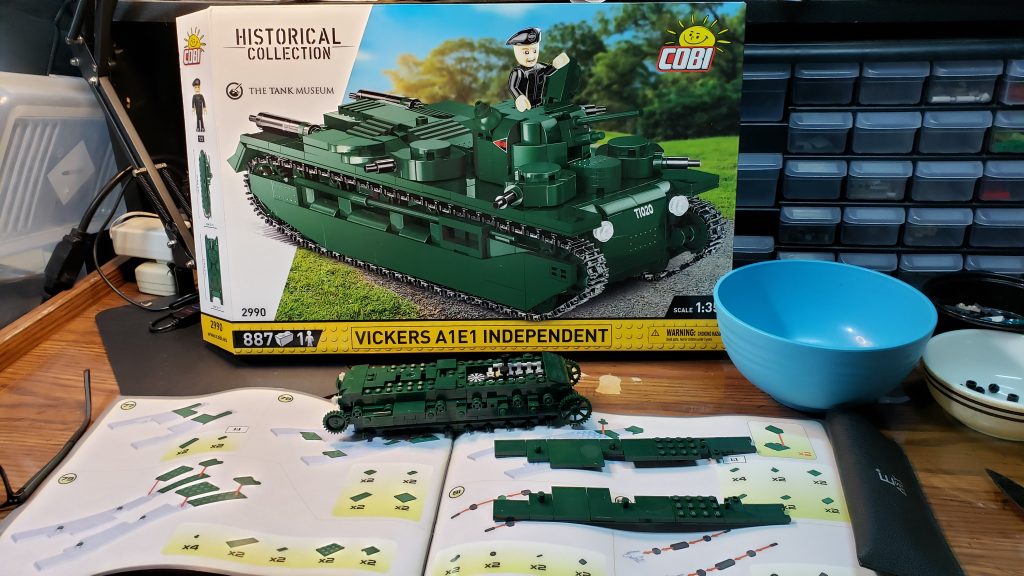
This is the initial progress. Less than 1000 bricks so it will be a quick build.
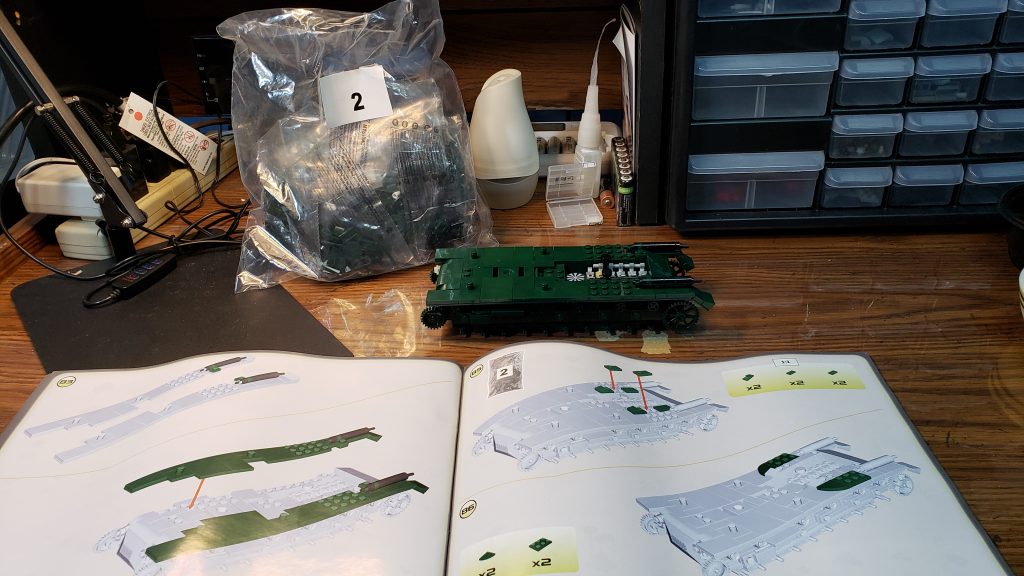
Bag 1 is done and getting ready to start bag 2. Depending on when I decide to work on it the build will be done shortly.

The Independent A1E1 is a multi-turreted tank that was designed by the British armaments manufacturer Vickers between the First and Second World Wars. Although it only ever reached the prototype stage and only a single example was built, it influenced many other tank designs.

The A1E1 design can be seen as a possible influence on the Soviet T-100 and T-28 tanks, the German Neubaufahrzeug tanks, and the British Medium Mk III and Cruiser Mk I (triple turret) tank designs. The Soviet T-35 tank was heavily influenced by its design.

Previous Build

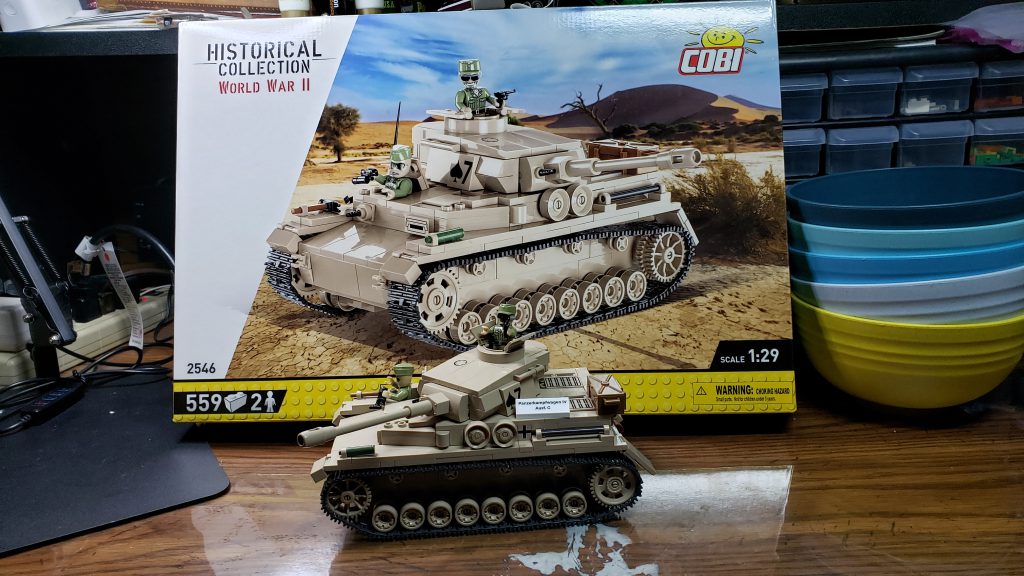
Panzer IV Ausf. G

The Panzerkampfwagen IV (Pz.Kpfw. IV), commonly known as the Panzer IV, is a German medium tank developed in the late 1930s and used extensively during the Second World War. Its ordnance inventory designation was Sd.Kfz. 161.

The Panzer IV was the most numerous German tank and the second-most numerous German fully tracked armoured fighting vehicle of the Second World War; 8,553 Panzer IVs of all versions were built during World War II, only exceeded by the StuG III assault gun with 10,086 vehicles. Its chassis was also used as the base for many other fighting vehicles, including the Sturmgeschütz IV assault gun, the Jagdpanzer IV self-propelled anti-tank gun, the Wirbelwind self-propelled anti-aircraft gun, and the Brummbär self-propelled gun.

The Panzer IV saw service in all combat theatres involving Germany and was the only German tank to remain in continuous production throughout the war. It was originally designed for infantry support, while the similar Panzer III was to fight armoured fighting vehicles. However, as the Germans faced the formidable T-34, the Panzer IV had more development potential, with a larger turret ring to mount more powerful guns, so it swapped roles with the Panzer III whose production wound down in 1943. The Panzer IV received various upgrades and design modifications, intended to counter new threats, extending its service life. Generally, these involved increasing the armour protection or upgrading the weapons, although during the last months of the war, with Germany’s pressing need for rapid replacement of losses, design changes also included simplifications to speed up the manufacturing process.

The Panzer IV was partially succeeded by the Panther medium tank, which was introduced to counter the Soviet T-34, although it continued to be a significant component of German armoured formations to the end of the war. It was the most widely exported tank in German service, with around 300 sold to Finland, Romania, Spain and Bulgaria. After the war, Syria procured Panzer IVs from France and Czechoslovakia, which saw combat in the 1967 Six-Day War.

Three months after beginning production, the Panzer IV Ausf. F2 was renamed Ausf. G.

During its production run from March 1942 to June 1943, the Panzer IV Ausf. G went through further modifications, including another armour upgrade which consisted of a 30-millimetre (1.18 in) face-hardened appliqué steel plate welded (later bolted) to the glacis—in total, frontal armour was now 80 mm (3.15 in) thick. This decision to increase frontal armour was favorably received according to troop reports on 8 November 1942, despite technical problems of the driving system due to added weight. At this point, it was decided that 50% of Panzer IV production would be fitted with 30 mm (1.18 in) thick additional armour plates. On 5 January 1943, Hitler decided that all Panzer IV should have 80 mm (3.15 in) frontal armour. To simplify production, the vision ports on either side of the turret and the loader’s forward vision port in the turret front were removed, while a rack for two spare road wheels was installed on the track guard on the left side of the hull. Complementing this, brackets for seven spare track links were added to the glacis plate.

For operation in high temperatures, the engine’s ventilation was improved by creating slits over the engine deck to the rear of the chassis, and cold weather performance was boosted by adding a device to heat the engine’s coolant, as well as a starter fluid injector. A new light replaced the original headlight and the signal port on the turret was removed. On 19 March 1943, the first Panzer IV with Schürzen skirts on its sides and turret was exhibited. The double hatch for the commander’s cupola was replaced by a single round hatch from very late model Ausf. G. and the cupola was up-armoured from 50 mm (1.97 in) to 95 mm (3.74 in). In April 1943, the KwK 40 L/43 was replaced by the longer 75-millimetre (2.95 in) KwK 40 L/48 gun, with a redesigned multi-baffle muzzle brake with improved recoil efficiency. The longer L/48 resulted in the introduction of the Turmzielfernrohr 5f/1 optic.

2
0

What’s Walrus Building?

At the moment nothing. Just finished up the HMS Hood which you will see below. I am now aiting on some WWI tanks, Sturmpanzerwagen A7V and Vickers A1E1. They should arrive early next week. But lets see the development of the HMS Hood since last week where we got the hull done.

Completed hull and moving on to bag 6.

Base of the superstructer is complete and with no problems moving on to bag 7.

Slow going but the superstructure continues to take shape.

The mast were a bit of a pain but we have reached the point where we just need to add the guns and anchor chains. The Anchor chains are small and very annoying to link together.

The HMS Hood is done and ready to get sunk by the Bismarck. One thing I found out was that it was a little longer than my shelf space. Had to angle it a bit but it fits so it sits.

HMS Hood (pennant number 51) was a battlecruiser of the Royal Navy (RN). Hood was the first of the planned four Admiral-class battlecruisers to be built during the First World War. Already under construction when the Battle of Jutland occurred in mid-1916, that battle revealed serious flaws in her design despite drastic revisions before she was completed four years later. For this reason, she was the only ship of her class to be completed, as the Admiralty decided it would be better to start with a clean design on succeeding battlecruisers, leading to the never-built G-3 class. Despite the appearance of newer and more modern ships, Hood remained the largest warship in the world for 20 years after her commissioning, and her prestige was reflected in her nickname, “The Mighty Hood”.

Hood was involved in many showing-the-flag exercises between her commissioning in 1920 and the outbreak of war in 1939, including training exercises in the Mediterranean Sea and a circumnavigation of the globe with the Special Service Squadron in 1923 and 1924. She was attached to the Mediterranean Fleet following the outbreak of the Second Italo-Ethiopian War in 1935. When the Spanish Civil War broke out the following year, Hood was officially assigned to the Mediterranean Fleet until she had to return to Britain in 1939 for an overhaul. By this time, advances in naval gunnery had reduced Hood‘s usefulness. She was scheduled to undergo a major rebuild in 1941 to correct these issues, but the outbreak of the Second World War in September 1939 kept the ship in service without the upgrades.

When war with Germany was declared, Hood was operating in the area around Iceland, and she spent the next several months hunting for German commerce raiders and blockade runners between Iceland and the Norwegian Sea. After a brief overhaul of her propulsion system, she sailed as the flagship of Force H, and participated in the destruction of the French fleet at Mers-el-Kebir. Transferred to the Home Fleet shortly afterwards, Hood was dispatched to Scapa Flow, and operated in the area as a convoy escort and later as a defence against a potential German invasion fleet.

In May 1941, Hood and the battleship Prince of Wales were ordered to intercept the German battleship Bismarck and the heavy cruiser Prinz Eugen, which were en route to the Atlantic, where they were to attack convoys. On 24 May 1941, early in the Battle of the Denmark Strait, Hood was struck by several German shells, exploded, and sank with the loss of all but 3 of her crew of 1,418. Due to her publicly perceived invincibility, the loss affected British morale.

The RN conducted two inquiries into the reasons for the ship’s quick demise. The first, held soon after the ship’s loss, concluded that Hood‘s aft magazine had exploded after one of Bismarck‘s shells penetrated the ship’s armour. A second inquiry was held after complaints that the first board had failed to consider alternative explanations, such as an explosion of the ship’s torpedoes. It was more thorough than the first board but concurred with the first board’s conclusion. Despite the official explanation, some historians continued to believe that the torpedoes caused the ship’s loss, while others proposed an accidental explosion inside one of the ship’s gun turrets that reached down into the magazine. Other historians have concentrated on the cause of the magazine explosion. The discovery of the ship’s wreck in 2001 confirmed the conclusion of both boards, although the exact reason the magazines detonated is likely to remain unknown, since that portion of the ship was obliterated in the explosion.

Previous Builds

Panzerjager Tiger Ausf B

The Jagdtiger (“Hunting Tiger”; officially designated Panzerjäger Tiger Ausf. B[citation needed]) is a German casemate-type heavy tank destroyer (Jagdpanzer) of World War II. It was built upon the slightly lengthened chassis of a Tiger II. Its ordnance inventory designation was Sd.Kfz. 186.

The 72-tonne Jagdtiger was the heaviest armored fighting vehicle (AFV) used operationally by any nation in WWII and the heaviest combat vehicle of any type to be produced during the conflict. It was armed with a 12.8 cm Pak 44 L/55 main gun which could out-range and defeat any AFV fielded by the Allied forces.

It saw brief service in small numbers from late 1944 until the end of the war on both the Western and Eastern Front. Although 150 were ordered, only around 80 were produced. Due to an excessive weight and an underpowered drivetrain system, the Jagdtiger was plagued with mobility and mechanical problems. Three Jagdtigers survive in museums.

What’s Walrus building?

Hi. I got one done that I started last week, see it in the previous builds section. I am currently working on the HMS Hood. Let’s check out the progress.

Over 2500 pieces so this will take awhile to get done but progress has been steady with no major screw ups. So far.

Bag 1 is complete and so is the bow.

Bag 2 continues the bow into the midsection. I will say the build is easier with the different colored blocks. It makes it easier to spot the right block and since it is the internal structure the color doesn’t matter. Wish they had been doing this sooner.

Bag 3 was the stern and once again no problems.

Bag 4 completed the stern and also started the basic midships so we have the full hull joined and ready to fill out. That will be next week.

Previous builds.

I teased this last week so here it is completed.

Sd. Kfz. 243/3 Stummel

The Sd.Kfz. 234 (Sonderkraftfahrzeug 234, Special Purpose Vehicle 234), was a family of armoured cars designed and built in Germany during World War II. The vehicles were lightly armoured, armed with a 20, 50 or 75 mm main gun, and powered by a Tatra V12 diesel engine. The Sd.Kfz. 234 broadly resembles the appearance of Sd.Kfz. 231 (8 rad).

The Sd.Kfz. 234/3, produced simultaneously with the 234/1, served as a support vehicle for the reconnaissance vehicles. It had an open-topped superstructure, in which a short-barreled 7.5 cm K51 L/24 gun was installed. This gun was intended for use against “soft” targets; however, when using a hollow charge shell, the penetration power exceeded that of the 5 cm L/60 gun. This variant was produced from mid 1944 to the end of 1944, before switching production to the 234/4.

Ford V3000s Maultier

Maultier (English: “mule“) or Sd.Kfz. 3 is the name given to series of half-track trucks used by Nazi Germany during World War II. They were based on Opel, Mercedes-Benz, Alfa Romeo or Ford trucks.

History

Soon after invading the USSR, German troops discovered that their wheeled transport vehicles were unsuitable for the sparse road network, particularly in the muddy conditions of the rasputitsa. Only half tracks like the Sd.Kfz. 11 could haul supplies to forward units in these conditions, but removing them from their combat role for supply duties was not feasible, so it was decided to produce half-tracked versions of standard Opel, Daimler-Benz, Alfa-Romeo and Ford trucks (lorries) by removing their rear axles, truncating the prop-shafts and connecting them to redundant Panzer I track assemblies. Heavier trucks (4 tons payload) were fitted with Panzer II track assemblies.

Horstmann suspension components employed by the Panzer I was practically identical to the light tank track system used on the Universal Carrier, with the Maultier’s use of them closely resembling the roadwheel/suspension system used by the T16 American-produced version in its roadwheel design. Most Maultier conversions were based on Opel Blitz model S trucks, which proved successful in service.

Although they lacked the overall mobility of purpose-built half tracks, they were cheaper and sufficiently effective. From 1943 some Maultier trucks were fitted with armored bodies, designated Sd.Kfz. 4. Some of these were armed with ten-tube rocket launcher Panzerwerfer 42, and were designated Sd.Kfz.. 4/1.

What’s Walrus building?

Well this turned into a fine mess. You may remember I was going to start on the motorized Tiger.

Things went along without much trouble. Not no trouble, but correctable minor problems. Things went fine with the chassis.

At this point you may notice the tilting red bricks where the turret would have to attach to and all I can say it was really hard to get the bricks to lock properly with the completed turret. But eventually I succeeded.

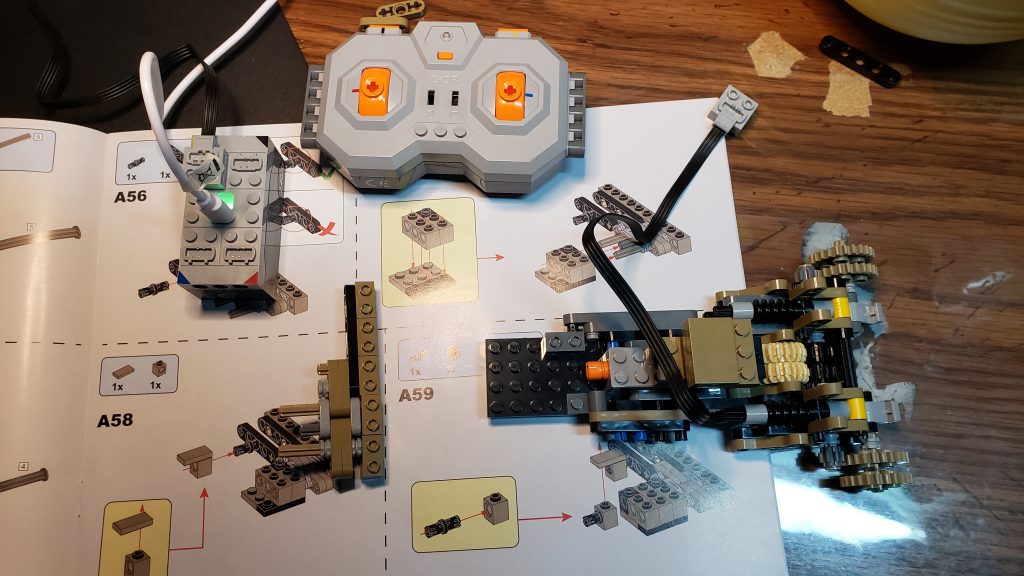
Now the real problem. I charged up the battery and got the remote ready and then…

nothing. Nothing worked. The only problem may have been the connections to the motor and, dummy that I am, I didn’t not check to see if they were working properly before proceeding with the build. That means my only recourse is to take it all apart and start from the tank body before motor installation. I may do that, probably, but I’m leaving this aside until later.

After this fiasco I did some other builds which will show up in the previous build section. I have put in an order for the HMS Hood to go with my Bismarck build and I await delivery. In the meantime I am going to start this one next.

Less than 500 bricks, should be a quick build.

Previous Builds

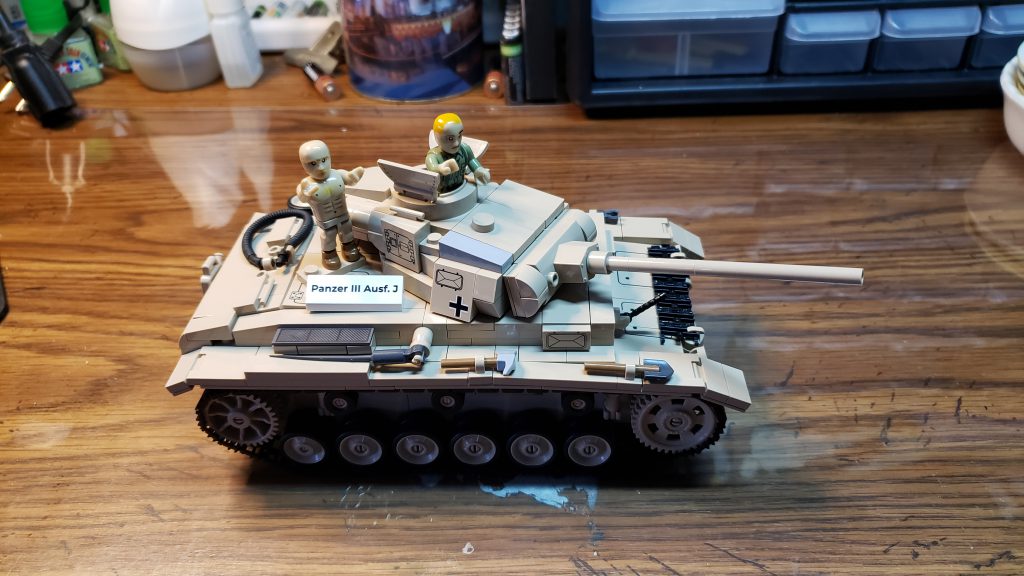
Panzer III Ausf. J

The Panzerkampfwagen III, commonly known as the Panzer III, was a medium tank developed in the 1930s by Germany, and was used extensively in World War II. The official German ordnance designation was Sd.Kfz. 141. It was intended to fight other armoured fighting vehicles and serve alongside and support the similar Panzer IV, which was originally designed for infantry support.

Initially the Panzer III had the same 3.7 cm gun as the infantry used for anti-tank work but later models were given 5 cm gun. However, this was the largest gun that could be fitted within the limitations of the turret ring and it was insufficient against Soviet T-34 and KV-1 tanks. Instead the Panzer IV which had a larger turret ring, was redesigned to mount the long-barrelled 7.5 cm KwK 40 gun and became the main German tank. The Panzer III effectively swapped roles with the Panzer IV; from 1942 the last version of the Panzer III (Panzer III N) mounted the short barrelled 7.5 cm KwK 37 L/24 that the first Panzer IVs had been fitted with.

Production of the Panzer III ceased in 1943 but the Sturmgeschütz III assault gun which had been developed from the Panzer III chassis continued in production until the end of the war.

The most common variant of the Panzer III, which served in North Africa and the Eastern Front. Hull and turret front armour increased to solid 50 mm plate. Spaced armour was placed around the gun mantlet.

Stug III Ausf. F/8

(I also did one of these as the Flammpanzer variant)

The Sturmgeschütz III (StuG III) was an assault gun produced by Germany during World War II. It was the most-produced fully tracked armoured fighting vehicle, and second-most produced German armored combat vehicle of any type after the Sd.Kfz. 251 half-track. It was built on a slightly modified Panzer III chassis, replacing the turret with an armored, fixed superstructure mounting a more powerful gun. Initially intended as a mobile assault gun for direct-fire support for infantry, the StuG III was continually modified, and much like the later Jagdpanzer vehicles, was employed as a tank destroyer.

StuG III Ausf. F: (Sd.Kfz 142/1; March–September 1942, 366 produced) The first real up-gunning of the StuG, this version uses the longer 7.5 cm StuK 40 L/43 gun. Firing armour-piercing Panzergranat-Patrone 39, the StuK 40 L/43 could penetrate 91 mm of armour inclined 30 degrees from vertical at 500 m, 82 mm at 1,000 m, 72 mm at 1,500 m, 63 mm at 2,000 m, allowing the Ausf. F to engage most Soviet armoured vehicles at normal combat ranges. This change marked the StuG as being more of a tank destroyer than an infantry support vehicle. An exhaust fan was added to the rooftop to evacuate fumes from spent shells, to enable the firing of continuous shots. Additional 30 mm armour plates were welded to the 50 mm frontal armour from June 1942, making the frontal armour 80 mm thick. From June 1942, Ausf. F were mounted with approximately 13 inch (334 mm to be exact) longer 7,5 cm StuK 40 L/48 gun. Firing above mentioned ammunition, longer L/48 could penetrate 96 mm, 85 mm, 74 mm, 64 mm respectively (30 degrees from vertical).

What’s Walrus Building?

Time marches on and I am zooming through my builds, zooming!

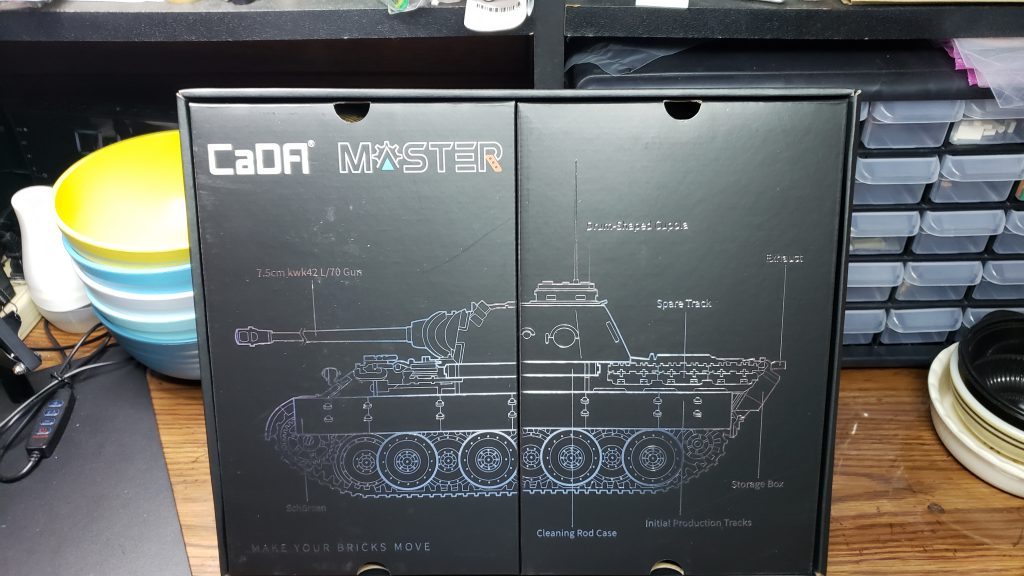
My current build is that CadFi motorized Tiger.

I’ll post the progress pics next week. So far, no missing pieces.

I got two others completed since last week. First up is the “Puma”.

 Sd. Kfz. 234/2 Puma

Here is an early pic of the build.

 Sd. Kfz. 234/2 Puma

The Sd.Kfz. 234 (Sonderkraftfahrzeug 234, Special Purpose Vehicle 234), was a family of armoured cars designed and built in Germany during World War II. The vehicles were lightly armoured, armed with a 20, 50 or 75 mm main gun, and powered by a Tatra V12 diesel engine. The Sd.Kfz. 234 broadly resembles the appearance of Sd.Kfz. 231 (8 rad).

My other build goes back to World War One.

Mark I (male) no. C.19.

Mark I (male) no. C.19.

The Mark I entered service into World War I on August 1916. It was first used on the morning of September 15th, 1916 during the battle of Flers-Courcelette, which was a part of the Sommes Offensive. With the new Exception of Mark II And Mark III, followed by a largely similar Mark IV. The Mark IV was used on a mass scale for that time. 460 tanks in the battle for Cambrai in November 1917. The later Mark V had better transmission, entering service in the middle of 1918. More than two thousand of these tanks were manufactured. This was discontinued at the end of WWI.

Past Builds

PanzerJager Tiger Ausf. B

PanzerJager Tiger Ausf. B

The Jagdtiger (“Hunting Tiger”; officially designated Panzerjäger Tiger Ausf. B[citation needed]) is a German casemate-type heavy tank destroyer (Jagdpanzer) of World War II. It was built upon the slightly lengthened chassis of a Tiger II. Its ordnance inventory designation was Sd.Kfz. 186.

The 72-tonne Jagdtiger was the heaviest armored fighting vehicle (AFV) used operationally by any nation in WWII and the heaviest combat vehicle of any type to be produced during the conflict. it was armed with a 12.8 cm Pak 44 L/55 main gun which could out-range and defeat any AFV fielded by the Allied forces.

It saw brief service in small numbers from late 1944 until the end of the war on both the Western and Eastern Front. Although 150 were ordered, only around 80 were produced. Due to an excessive weight and an underpowered drivetrain system, the Jagdtiger was plagued with mobility and mechanical problems. Three Jagdtigers survive in museums.

See ya next week.

What’s Walrus Building?

Well we have hit complications. I started the motorized Panther.

Got started and things proceeded fairly easily up to this point.

It was then I found I was missing a part. Since it was a unique one I could not replace with my spares I had to stop. Now, with a Cobi set this would be no real problem as they are pretty good at replacing parts although it takes a little while for them to come from Poland. Yes, these sets are produced in Poland. The CadFi sets though are made in China and it is unclear what kind of “Proof of Puchase” they need to be able to send me a part. Also coming from China I can’t predict how long that will take so I switch to my other waiting builds. I got two done which you’ll see in the previous builds section. I am now working on this.

I have part of the hull done and the work continues. I hope everyone is ready to enjoy a Merry Christmas and a Happy New Year.

Previous Builds

Panzer III Ausf. J

The Panzerkampfwagen III, commonly known as the Panzer III, was a medium tank developed in the 1930s by Germany, and was used extensively in World War II. The official German ordnance designation was Sd.Kfz. 141. It was intended to fight other armoured fighting vehicles and serve alongside and support the similar Panzer IV, which was originally designed for infantry support.

Initially the Panzer III had the same 3.7 cm gun as the infantry used for anti-tank work but later models were given 5 cm gun. However, this was the largest gun that could be fitted within the limitations of the turret ring and it was insufficient against Soviet T-34 and KV-1 tanks. Instead the Panzer IV which had a larger turret ring, was redesigned to mount the long-barrelled 7.5 cm KwK 40 gun and became the main German tank. The Panzer III effectively swapped roles with the Panzer IV; from 1942 the last version of the Panzer III (Panzer III N) mounted the short barrelled 7.5 cm KwK 37 L/24 that the first Panzer IVs had been fitted with.

Production of the Panzer III ceased in 1943 but the Sturmgeschütz III assault gun which had been developed from the Panzer III chassis continued in production until the end of the war.

Panzer III Ausf. J – The most common variant of the Panzer III, which served in North Africa and the Eastern Front. Hull and turret front armour increased to solid 50 mm plate. Spaced armour was placed around the gun mantlet. Some were produced with 5 cm KwK 39 L/60 gun and later redesignated Ausf. L.

Panzer IV Ausf. G

The Panzerkampfwagen IV (Pz.Kpfw. IV), commonly known as the Panzer IV, is a German medium tank developed in the late 1930s and used extensively during the Second World War. Its ordnance inventory designation was Sd.Kfz. 161.

The Panzer IV was the most numerous German tank and the second-most numerous German fully tracked armoured fighting vehicle of the Second World War; 8,553 Panzer IVs of all versions were built during World War II, only exceeded by the StuG III assault gun with 10,086 vehicles. Its chassis was also used as the base for many other fighting vehicles, including the Sturmgeschütz IV assault gun, the Jagdpanzer IV self-propelled anti-tank gun, the Wirbelwind self-propelled anti-aircraft gun, and the Brummbär self-propelled gun.

The Panzer IV saw service in all combat theatres involving Germany and was the only German tank to remain in continuous production throughout the war. It was originally designed for infantry support, while the similar Panzer III was to fight armoured fighting vehicles. However, as the Germans faced the formidable T-34, the Panzer IV had more development potential, with a larger turret ring to mount more powerful guns, so it swapped roles with the Panzer III whose production wound down in 1943. The Panzer IV received various upgrades and design modifications, intended to counter new threats, extending its service life. Generally, these involved increasing the armour protection or upgrading the weapons, although during the last months of the war, with Germany’s pressing need for rapid replacement of losses, design changes also included simplifications to speed up the manufacturing process.

The Panzer IV was partially succeeded by the Panther medium tank, which was introduced to counter the Soviet T-34, although it continued to be a significant component of German armoured formations to the end of the war. It was the most widely exported tank in German service, with around 300 sold to Finland, Romania, Spain and Bulgaria. After the war, Syria procured Panzer IVs from France and Czechoslovakia, which saw combat in the 1967 Six-Day War.

1,927 produced by Krupp-Gruson, Vomag and Nibelungenwerke from March 1942 to June 1943.

What’s Walrus Building?

It is done! Man was that a job. So often getting one piece in place properly popped another one out somewhere else. It was quite frustrating resulting in me having to glue key areas so they wouldn’t pop out on me.

After the problem of the exhausts was solved the above was the next big problem. The turrent ring attachments were too tight and would pop out connections. I eventually had to alter the placement of the posts in reverse of the instructions so they would fit properly. Someone messed up the instructions.

I had to do the turret plating twice to get it to sit properly on the chassis. Once again being frustrating by having to apply pressure to lock on set of bricks which would pop out other connected ones elsewhere. It is something I’ve come to expect but hate about these builds. On some it doesn’t happen and on others it seems to happen every 10 minutes. The Tiger was especially so. But it is done!

It is one big mother for sure. Now on to the next build for which I have 6 models on deck. I think it will be the motorized Panther since I have never built a moving one. When I actually start it depends upon the Holiday season and what is taking up my time.

Previouis Build

M4A3E8 Sherman Easy Eight
The M4 Sherman is, by a comfortable margin, the most recognisable of the Allied tanks of World War II (at least to a Western audience). Thousands were built and supplied to all the major Allied powers, and their combat performance was, if not spectacular, thoroughly satisfactory, with the sheer number of available vehicles being a significant contributor to the eventual defeat of Nazi Germany. Of the many, many Sherman variants that would be developed, one of the most famous (and effective) was the M4A3E8 – more formally the M4A3(76)W HVSS, known for the sake of convenience and sanity as the ‘Easy Eight’ (from the E8 suffix and comfortable ride).

The Easy Eight was arguably the most well-rounded of the Second World War Sherman variants, combining welded hull construction and wet ammunition storage for survivability with the mobility of the smooth-riding Horizontal Volute Spring Suspension (HVSS) system and attendant wider tracks, and the anti-tank punch of the excellent 76mm Gun M1. Specifically designed to counter the increasingly heavy German armour encountered as US forces pushed towards Germany, the Easy Eight was capable of engaging and destroying all marques of Panzer IVs at combat ranges, and the 76mm gun could usually threaten the heavier German tanks from the sides and rear. Against the lighter opposition encountered on other fronts, they proved absolutely devastating, although most were deployed to Western Europe. With around 2,500 made, there were never enough to go around, the type never completely replaced the 75mm-armed types in service during the Second World War (although the excellent high explosive rounds available to the 75mm meant that having a mix of the two types in the same unit was often considered beneficial), but the Easy Eight was at its core still a Sherman, with all the reliability and consistency that name entailed. Well-liked by its crews, it was considered a potent and viable weapon, although it did not completely address the demand for more firepower in armoured units, this need increasingly being filled by the Tank Destroyer branch. A good number were also deployed during the war by Canadian units.

As an excellent, reliable medium tank, the Easy Eight unsurprisingly remained in service post-war, and would be deployed in significant numbers and see combat with a number of operators in the Korean War, maintaining its reputation as a rugged, reliable machine despite being rendered technically obsolescent by tanks such as the Centurion and Pershing. Not fully retired from US service until 1957, the Easy Eight would also enjoy a surprisingly long life in other militaries across the world. As surplus World War II US military hardware flooded the export market in the late 1940s and into the 1950s, ‘Easy Eights’ would go on to serve with many countries, seeing particularly heavy service in Israeli colours, and continue to see limited action until well into the 1970s and beyond, albeit often modified far beyond their original configuration. Most recently, an Easy Eight was the star of the film Fury – while much of the historicity may be a little dubious, it does give us plenty of lovely shots of a real example of the tank in ‘action’.

What’s Walrus Building?

To be honest. Nothing. I was cruising along fairly well when disaster struck. I was putting on the outside of the turrent when the pressures popped parts off the base in various places. So many I could not put it back together. Many hours of work down the drain. I had to break it apart to start all over which I haven’t done. So I pause, gather my will once again and see if this time I don’t mess it up.

On to past glories.

Past Builds

Panzerkampfwagen Tiger Ausf. B

The Tiger II was a German heavy tank of the Second World War. The final official German designation was Panzerkampfwagen Tiger Ausf. B, often shortened to Tiger B. The ordnance inventory designation was Sd.Kfz. 182. (Sd.Kfz. 267 and 268 for command vehicles). It was also known informally as the Königstiger (German for Bengal tiger and also, literally, “King Tiger”). Contemporaneous Allied soldiers usually called it the King Tiger or Royal Tiger.

The Tiger II was the successor to the Tiger I, combining the latter’s thick armour with the armour sloping used on the Panther medium tank. The tank weighed almost 70 tonnes, and was protected by 100 to 185 mm (3.9 to 7.3 in) of armour to the front. It was armed with the long barrelled 8.8 cm KwK 43 L/71 anti-tank cannon. The chassis was also the basis for the Jagdtiger turretless Jagdpanzer anti-tank vehicle.

The Tiger II was issued to heavy tank battalions of the Army and the Waffen-SS. It was first used in combat by 503rd Heavy Panzer Battalion during the Allied invasion of Normandy on 11 July 1944; on the Eastern Front, the first unit to be outfitted with the Tiger II was the 501st Heavy Panzer Battalion, which by 1 September 1944 listed 25 Tiger IIs operational.

What’s Walrus building?

Honestly still working on the Tiger but no progress made. Having a little difficulty with exhaust system which has two bends in it which makes it impossible to get it to stay attached in certain places. I’ll have to go to the old stand by, gluing the problematic connections. Sadly so time the Lego blocks just won’t stay locked.

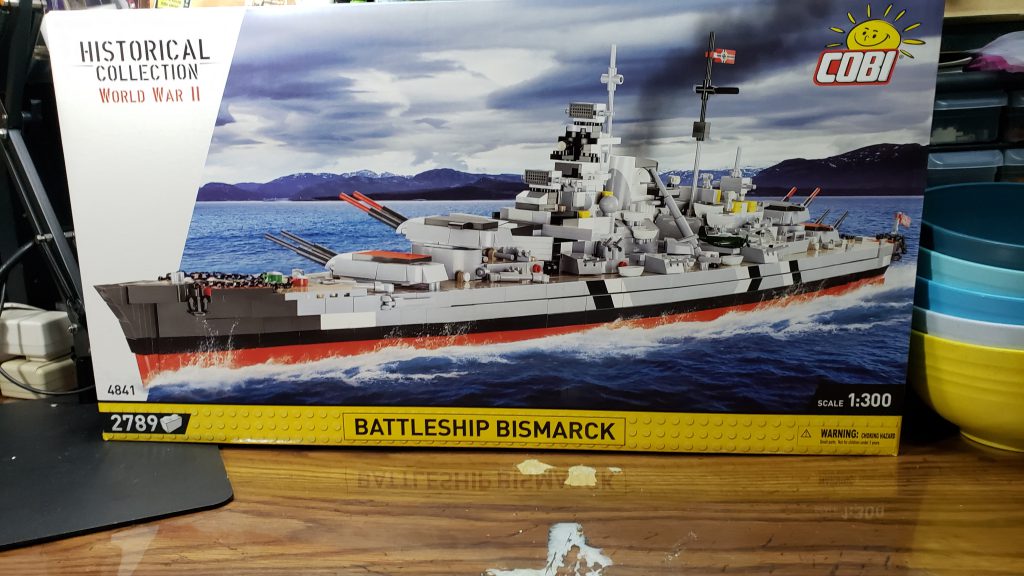
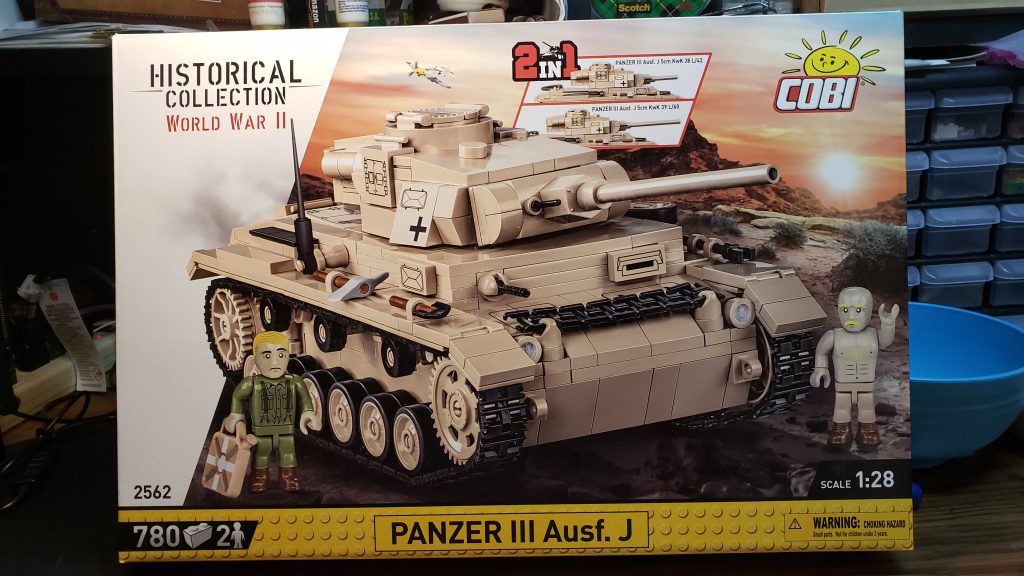
I have not been indolent on the buying front however. Besides the motorized Tiger and Panther I already have waiting there were sales galore between Cobi and Warbricks so I now also have waiting to go another verson of the Panzer III Ausf J., a British WWI Mark I Male tank, Panzer IV AUSF. G  and the Battleship Bismark. That hopefully should last me to spring or another sale. Who knows.

Previous Builds

Panzerkampfwagen VIII Maus (English: ‘mouse’) was a German World War II super-heavy tank completed in late 1944. It is the heaviest fully enclosed armored fighting vehicle ever built. Five were ordered, but only two hulls and one turret were completed, the turret being attached before the testing grounds were captured by advancing Soviet military forces. This vehicle was also built to compete with the Soviet heavy Kliment Voroshilov tank. These two prototypes underwent trials in late 1944. The complete vehicle was 10.2 m (33 ft) long, 3.71 m (12.2 ft) wide and 3.63 m (11.9 ft) high. Weighing 188 metric tons, the Maus’s main armament was the Krupp-designed 128 mm KwK 44 L/55 gun, based on the 12.8 cm Pak 44 towed anti-tank gun also used in the casemate-type Jagdtiger tank destroyer, with a coaxial 75 mm KwK 44 L/36.5 gun. The 128 mm gun was powerful enough to destroy all Allied armored fighting vehicles in service at the time, with some at ranges exceeding 3,500 m (3,800 yd). The principal problem in the design of the Maus was developing an engine and drivetrain which was powerful enough to adequately propel the tank, yet small enough to fit inside it – as it was meant to use the same sort of “hybrid drive”, using an internal-combustion engine to operate an electric generator to power its tracks with electric motor units, much as its Porsche-designed predecessors, the VK 30.01 (P), VK 45.01 (P), and Elefant had. The drivetrain was electrical, designed to provide a maximum speed of 20 km/h (12 mph) and a minimum speed of 1.5 km/h (0.9 mph). However, during actual field testing, the maximum speed achieved on hard surfaces was 13 km/h (8.1 mph) with full motor field, and by weakening the motor field to a minimum, a top speed of 22 km/h (14 mph) was achieved. The vehicle’s weight made it unable to use most bridges; instead it was intended to ford to a depth of 2 m (6.6 ft) or submerge up to a depth of 8 m (26 ft) and use a snorkel to cross rivers. The Maus was intended to punch holes through enemy fortifications in the manner of an immense “breakthrough tank”, while taking virtually no damage to any components.

What’s Walrus Building?

Vegas made it a short work week but some progress was made. I got the front glacis on and the road wheels. The pins for the wheels were a real pain as they did not slide easily into place but they got done.

Probably another short week with all the Thanksgiving festivities coming up. I hope everyone has great plans for the holidays.

Previous builds.

Flakpanzer IV “Wirbelwind

The Flakpanzer IV “Wirbelwind“ (Whirlwind in English) was a German self-propelled anti-aircraft gun based on the Panzer IV tank. It was developed in 1944 as a successor to the earlier Möbelwagen self-propelled anti-aircraft gun.

In the first years of World War II, the German military forces had less interest in developing self-propelled anti-aircraft guns, but as the Allies began to gain air superiority, the need for more mobile and better-armed self-propelled anti-aircraft guns increased. During the early summer of 1944, SS-Hauptsturmführer Karl Wilhelm Krause with the 12th SS Panzer Division Hitlerjugend came up with the concept of the Flakpanzer IV Wirbelwind.[1] He presented the concept to SS-Obersturmbannführer Max Wünsche, commanding officer of the 12th SS Panzer Regiment and it was approved by Adolf Hitler.

The Panzer IV’s turret was removed and replaced with an open-top, nine-sided turret that housed a 2 cm Flakvierling 38, a quadruple mount of 20 mm cannon. A closed-top design would have been preferable, but this was not possible due to the heavy smoke generated by the four anti-aircraft guns. The shape of the turret earned it the nickname Keksdose (“biscuit tin”).[1] Production of the tank was carried out by Ostbau Werke in Sagan, Silesia.

While the turret’s four barrels were capable of firing 2 cm shells at a devastatingly high rate, it lacked range and was sometimes ineffective unless several shells hit an aircraft at once. Thus a more powerful successor, with an armament that hit harder and at longer range, was produced which eventually replaced it. Known as the Flakpanzer IV Ostwind (“East Wind”), the successor was equipped with a single 3.7 cm Flak 43.

Side view of Wirbelwind at CFB Borden

The combination of armor and rapid fire from the four guns of the Wirbelwind also made it very effective against lightly-armoured ground targets such as trucks and armored cars; infantry were particularly vulnerable.[3][failed verification]

Between 87 and 105 Wirbelwinds were converted from repaired Panzer IV chassis, but due to discrepancies between the recorded production numbers at Ostbau Werke and Wehrmacht service records, the actual number may never be known.

What’s Walrus Building?

I have to say I made a great deal of progress before I left on vacation. (Yes, I preposted this, why do you ask?)

Here was where I left off on the chassis.

You can see that the engine is in and the internals are coming along.

A closer look at the engine compartment.

The crew compartment for driver and radio operator.

The center where the turret will sit.

Another shot. (Pay no attention to the foot.)

Getting ready to put on the deck.

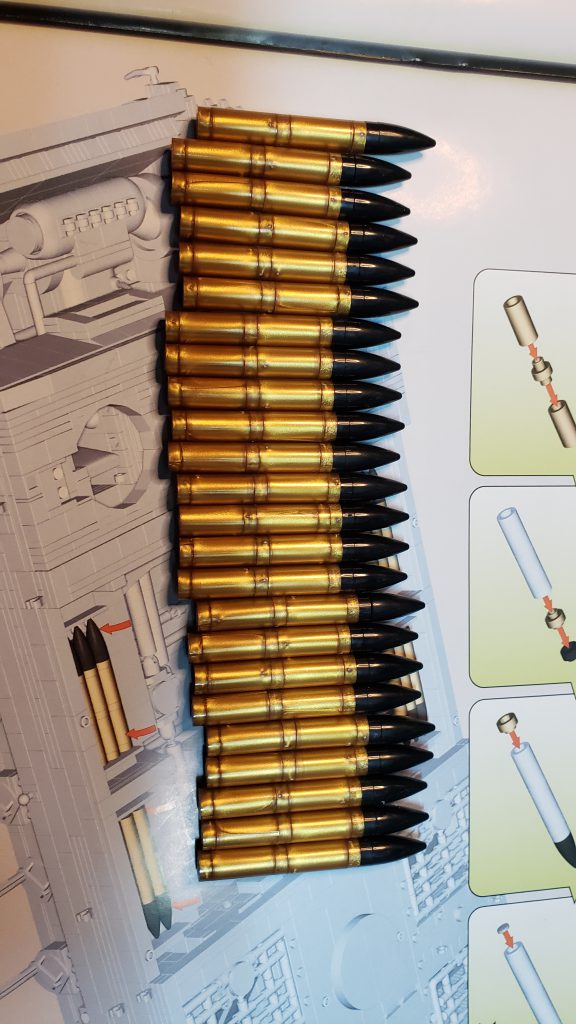
Before the deck goes in we build the 8.8 ammunition for the gun.

Loading up the storage compartments.

The deck cover is now in place and so endeth this phase.

Back from vacation it will be time for the wheels. Keeping it rolling. (Oh look another foot!)

Previous Build

USS Arizona BB-39

This was a 2 in 1 as you could also build it as the USS Pennsylvania.

USS Arizona was a battleship built for the United States Navy in the mid-1910s. Named in honor of the 48th state, she was the second and last ship in the Pennsylvania class. After being commissioned in 1916, Arizona remained stateside during World War I but escorted President Woodrow Wilson to the subsequent Paris Peace Conference. The ship was deployed abroad again in 1919 to represent American interests during the Greco-Turkish War. Two years later, she was transferred to the Pacific Fleet, under which the ship would remain for the rest of her career.

The 1920s and 1930s saw Arizona regularly deployed for training exercises, including the annual fleet problems, excluding a comprehensive modernization between 1929 and 1931. The ship supported relief efforts in the wake of a 1933 earthquake near Long Beach, California, and was later filmed for a role in the 1934 James Cagney film Here Comes the Navy before budget cuts led to significant periods in port from 1936 to 1938. In April 1940, the Pacific Fleet’s home port was moved from California to Pearl Harbor, Hawaii, as a deterrent to Japanese imperialism.

On 7 December 1941, the Japanese attacked Pearl Harbor, and Arizona was hit by several air-dropped armor-piercing bombs. One detonated an explosive-filled magazine, sinking the battleship and killing 1,177 of its officers and crewmen. Unlike many of the other ships attacked that day, Arizona was so irreparably damaged that it was not repaired for service in World War II. The shipwreck still lies at the bottom of Pearl Harbor beneath the USS Arizona Memorial. Dedicated to all those who died during the attack, the memorial is built across the ship’s remains.

What’s Walrus Building?

Another week in the books and progress has been made. Into Box three of four now no real worries. Doubt I will get in done before I leave but soon, soon.

Previous Builds.

IJN Yamato

Yamato (大和) was the lead ship of her class of battleships built for the Imperial Japanese Navy (IJN) shortly before World War II. She and her sister ship, Musashi, were the heaviest and most powerfully armed battleships ever constructed, displacing nearly 72,000 tonnes (71,000 long tons) at full load and armed with nine 46 cm (18.1 in) Type 94 main guns, which were the largest guns ever mounted on a warship.

Named after the ancient Japanese Yamato Province, Yamato was designed to counter the numerically superior battleship fleet of the United States, Japan’s main rival in the Pacific. She was laid down in 1937 and formally commissioned a week after the attack on Pearl Harbor in December 1941. Throughout 1942, she served as the flagship of the Combined Fleet, and in June 1942 Admiral Isoroku Yamamoto directed the fleet from her bridge during the Battle of Midway, a disastrous defeat for Japan. Musashi took over as the Combined Fleet flagship in early 1943, and Yamato spent the rest of the year moving between the major Japanese naval bases of Truk and Kure in response to American threats. In December 1943, Yamato was torpedoed by an American submarine which necessitated repairs at Kure, where she was refitted with additional anti-aircraft guns and radar in early 1944. Although present at the Battle of the Philippine Sea in June 1944, she played no part in the battle.

The only time Yamato fired her main guns at enemy surface targets was in October 1944, when she was sent to engage American forces invading the Philippines during the Battle of Leyte Gulf. While threatening to sink American troop transports, they encountered a light escort carrier group of the U.S. Navy‘s Task Force 77, “Taffy 3”, in the Battle off Samar. The Japanese turned back after American air attacks convinced them they were engaging a powerful U.S. carrier fleet.

During 1944, the balance of naval power in the Pacific decisively turned against Japan, and by early 1945 its fleet was much depleted and badly hobbled by critical fuel shortages in the home islands. In a desperate attempt to slow the Allied advance, Yamato was dispatched on a one-way mission to Okinawa in April 1945, with orders to beach herself and fight until destroyed, thus protecting the island. The task force was spotted south of Kyushu by U.S. submarines and aircraft, and on 7 April 1945 she was sunk by American carrier-based bombers and torpedo bombers with the loss of most of her crew.

What’s Walrus Building?

Thank God it’s Friday and I hope you all have a great weekend planned. I’ve got World Series watching and model building to do. Speaking of which.

I’ve gotten into box two of four and there were no great problems.

I’m up to bag 7 and might be able to finish the box off this weekend.

Previous Build

Focke-Wulf FW 190 A-3

The Fw 190 A-3 was equipped with the BMW 801 D-2 engine, which increased power to 1,700 PS (1,700 hp; 1,300 kW) at takeoff by improving the supercharger and raising the compression ratio. Because of these changes, the A-3 model required a higher octane fuel—100 (C3) versus 87 (B4). The A-3 retained the same weaponry as the A-2. The A-3 also introduced the Umrüst-Bausätze factory conversion sets. The Fw 190 A-3/U1 and U2 were single experimental Fw 190s: U1 (W.Nr 130270) was the first 190 to have the engine mount extended by 15 cm (5.9 in), which would be standardized on the later production A-5 model. The U2 (W.Nr 130386) had RZ 65 73 mm (2.9 in) rocket launcher racks under the wings with three rockets per wing. There were also a small number of U7 aircraft tested as high-altitude fighters armed with only two 20 mm MG 151 cannon, but with reduced overall weight.

The Fw 190 A-3/U3 was the first of the Jabo (Jagdbomber), using an ETC-501 centerline bomb rack able to carry up to 500 kg (1,100 lb) of bombs or, with horizontal stabilizing bars, one 300 L (80 US gal) drop tank. The U3 retained the fuselage-mounted 7.92 mm (.312 in) MG 17s and the wing-mounted 20 mm MG 151 cannon, with the outer MG FF being removed.

The Fw 190 A-3/U4 was a reconnaissance version with two RB 12.5 cameras in the rear fuselage and an EK 16 gun camera or a Robot II miniature camera in the leading edge of the port wing root. Armament was similar to the U3, however, and the ETC 501 was usually fitted with a 300 L (80 US gal) drop tank. See A-2 for production numbers.

In autumn 1942, a political decision diverted 72 new aircraft to Turkey in an effort to keep that country friendly to the Axis powers. These were designated Fw 190 A-3a (a=ausländisch (foreign), designation for export models) and delivered between October 1942 and March 1943. The Turkish aircraft had the same armament as the A-1: four 7.92 mm (.312 in) synchronized MG 17 machine guns and two 20 mm MG FF cannon. There was no FuG 25 IFF device in the radio equipment.

What’s Walrus Building?

I’m back with this week’s “What’s Walrus Building?” I’ve got the update on how far I’ve gotten with the current build. The problems encountered, a previous build and a preview of two new builds I’ll get to after finishing the Tiger 1:12 which will be going on a long time. You know, I’m thinking I may need to get a new intern to host this for me. I’m such a busy man these days. Oh well, something for later. (Cities Skyline 2 drops Monday so my spare time may disappear.) First an old build.

1:144

Background

USS Tang (SS-306) was a Balao-class submarine of World War II, the first ship of the United States Navy to bear the name Tang. She was built and launched in 1943, serving until being sunk by her own torpedo off China in the Taiwan Strait on 24 October 1944.

In her short career in the Pacific War, Tang sank 33 ships totalling 116,454 tons. Commander Richard O’Kane received the Medal of Honor for her last two engagements (23 and 24 October 1944).

Tang was sunk during the last engagement by a circular run of her final torpedo, going down in 180 ft (55 m) of water. 78 men were lost, and the nine survivors were picked up by a Japanese frigate and taken prisoner of war. This was the only known time that a Momsen lung was used to escape a sunken submarine.

Current Build Tiger 1:12

Boy howdy was this a rough start. First though some information. This came in four separate boxes each one about the size of a single build. Here is the first box.

So it begins. Inside we find the usual multiple packets of grouped parts.

Got my sorting bins set up to keep them separate.

So the work begins and seems to go well.

The second packacge is just another one of these which then snaps together with the previously built one. I completed that when disaster struck. There was a slight misalignment with one of the outside parts but I could see why, unless it was the slightly different piece then the one required. But I couldn’t tell where or which piece it was and everything was over lapping. I had no choice but to start from scratch. So I wasted about 5 hours of build time to do so but I finally got it together properly.

I’m working through the next two packets and will show that in next week’s update. Hopefull things will go smoother from now on but one frustrating thing about the instructiions is that they are not always clear as to exactly where a piece goes and if you miss by 1 stub you may not find out until you’ve done a lot more work. Keeping my fingers crossed.

Future Builds

These are not Cobi builds, but use the same lego style bricks. What’s nifty is that they are motorized. I hope that does not make it too complicated but we will see. I had a coupon from Warbricks, they’re great. They basically sell the Cobi sets, who have their own site, but somethimes have builds not available elsewhere and some sales. Check them out if you are interested in military builds. So here is what is on deck. A Tiger and as Panther, surprise!

Until next week, peace out.

3
1

What’s Walrus Building?

Just thought I come out with a new series. Since I’ve been retired I’ve had to occupy my time so I have been building Lego models. Almost all WWII related. So I have decided to share with you all what I am currently building and what I’ve already completed. Hope you like it.

Current build

Just got it. Probably open it up and start Friday or Saturday. I’ll take ongoing photos of my progress.

Just finished

Kubelwagen (PKW Typ 82)

It’s one of the larger ones. A 1:12 scale like the upcoming Tiger. Most of the others I’ve done are 1:28-1:35. The ships are much bigg so have scaling from 1:144 to 1:300. I’ve got to get more shelf space.