
Thanks God it’s Friday and welcome all. I know you are keen to see what I am building currently and here it is.
Vickers A1E1 Independent
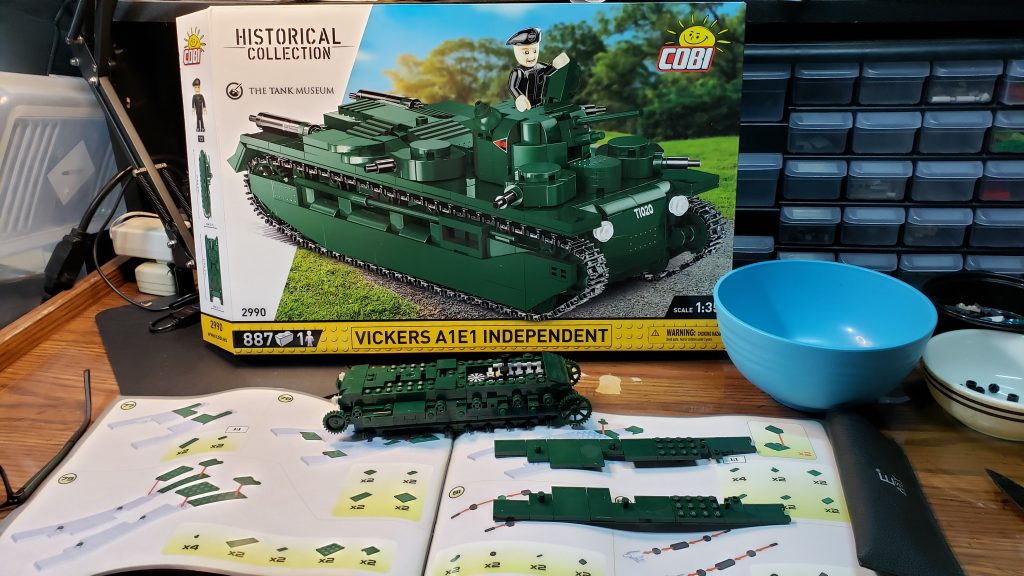
This is the initial progress. Less than 1000 bricks so it will be a quick build.
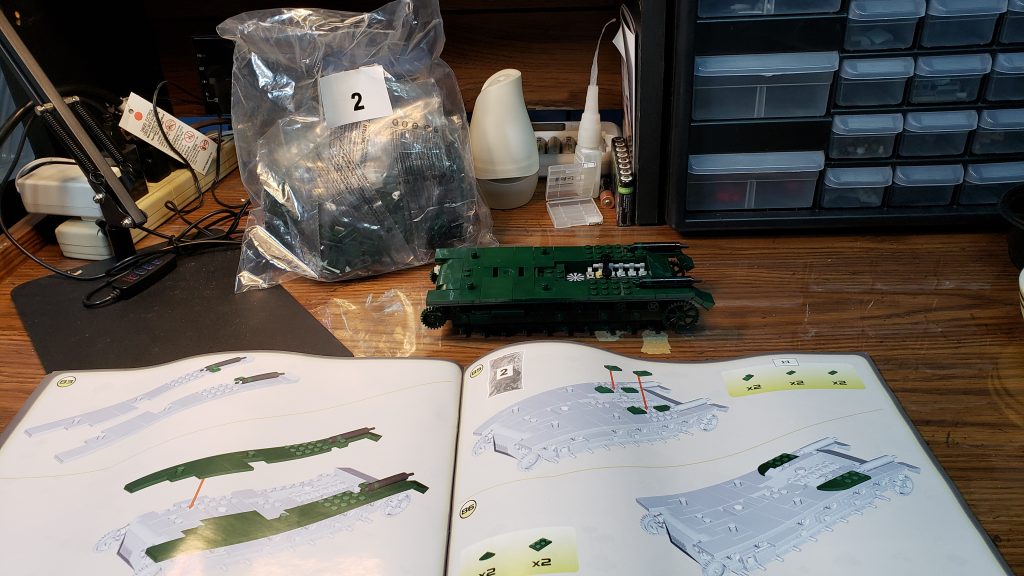
Bag 1 is done and getting ready to start bag 2. Depending on when I decide to work on it the build will be done shortly.
The Independent A1E1 is a multi-turreted tank that was designed by the British armaments manufacturer Vickers between the First and Second World Wars. Although it only ever reached the prototype stage and only a single example was built, it influenced many other tank designs.
The A1E1 design can be seen as a possible influence on the Soviet T-100 and T-28 tanks, the German Neubaufahrzeug tanks, and the British Medium Mk III and Cruiser Mk I (triple turret) tank designs. The Soviet T-35 tank was heavily influenced by its design.
Previous Build

Panzer IV Ausf. G
The Panzerkampfwagen IV (Pz.Kpfw. IV), commonly known as the Panzer IV, is a German medium tank developed in the late 1930s and used extensively during the Second World War. Its ordnance inventory designation was Sd.Kfz. 161.
The Panzer IV was the most numerous German tank and the second-most numerous German fully tracked armoured fighting vehicle of the Second World War; 8,553 Panzer IVs of all versions were built during World War II, only exceeded by the StuG III assault gun with 10,086 vehicles. Its chassis was also used as the base for many other fighting vehicles, including the Sturmgeschütz IV assault gun, the Jagdpanzer IV self-propelled anti-tank gun, the Wirbelwind self-propelled anti-aircraft gun, and the Brummbär self-propelled gun.
The Panzer IV saw service in all combat theatres involving Germany and was the only German tank to remain in continuous production throughout the war. It was originally designed for infantry support, while the similar Panzer III was to fight armoured fighting vehicles. However, as the Germans faced the formidable T-34, the Panzer IV had more development potential, with a larger turret ring to mount more powerful guns, so it swapped roles with the Panzer III whose production wound down in 1943. The Panzer IV received various upgrades and design modifications, intended to counter new threats, extending its service life. Generally, these involved increasing the armour protection or upgrading the weapons, although during the last months of the war, with Germany’s pressing need for rapid replacement of losses, design changes also included simplifications to speed up the manufacturing process.
The Panzer IV was partially succeeded by the Panther medium tank, which was introduced to counter the Soviet T-34, although it continued to be a significant component of German armoured formations to the end of the war. It was the most widely exported tank in German service, with around 300 sold to Finland, Romania, Spain and Bulgaria. After the war, Syria procured Panzer IVs from France and Czechoslovakia, which saw combat in the 1967 Six-Day War.
Three months after beginning production, the Panzer IV Ausf. F2 was renamed Ausf. G.
During its production run from March 1942 to June 1943, the Panzer IV Ausf. G went through further modifications, including another armour upgrade which consisted of a 30-millimetre (1.18 in) face-hardened appliqué steel plate welded (later bolted) to the glacis—in total, frontal armour was now 80 mm (3.15 in) thick. This decision to increase frontal armour was favorably received according to troop reports on 8 November 1942, despite technical problems of the driving system due to added weight. At this point, it was decided that 50% of Panzer IV production would be fitted with 30 mm (1.18 in) thick additional armour plates. On 5 January 1943, Hitler decided that all Panzer IV should have 80 mm (3.15 in) frontal armour. To simplify production, the vision ports on either side of the turret and the loader’s forward vision port in the turret front were removed, while a rack for two spare road wheels was installed on the track guard on the left side of the hull. Complementing this, brackets for seven spare track links were added to the glacis plate.
For operation in high temperatures, the engine’s ventilation was improved by creating slits over the engine deck to the rear of the chassis, and cold weather performance was boosted by adding a device to heat the engine’s coolant, as well as a starter fluid injector. A new light replaced the original headlight and the signal port on the turret was removed. On 19 March 1943, the first Panzer IV with Schürzen skirts on its sides and turret was exhibited. The double hatch for the commander’s cupola was replaced by a single round hatch from very late model Ausf. G. and the cupola was up-armoured from 50 mm (1.97 in) to 95 mm (3.74 in). In April 1943, the KwK 40 L/43 was replaced by the longer 75-millimetre (2.95 in) KwK 40 L/48 gun, with a redesigned multi-baffle muzzle brake with improved recoil efficiency. The longer L/48 resulted in the introduction of the Turmzielfernrohr 5f/1 optic.
Impressive but I won’t be satisfied until seeing them firing some live rounds, or are you already doing it? It’s legal, as you probably know.
Well I do have to BB shooting tanks, does that count?