
I have to say I made a great deal of progress before I left on vacation. (Yes, I preposted this, why do you ask?)
Here was where I left off on the chassis.

You can see that the engine is in and the internals are coming along.

A closer look at the engine compartment.

The crew compartment for driver and radio operator.

The center where the turret will sit.

Another shot. (Pay no attention to the foot.)

Getting ready to put on the deck.
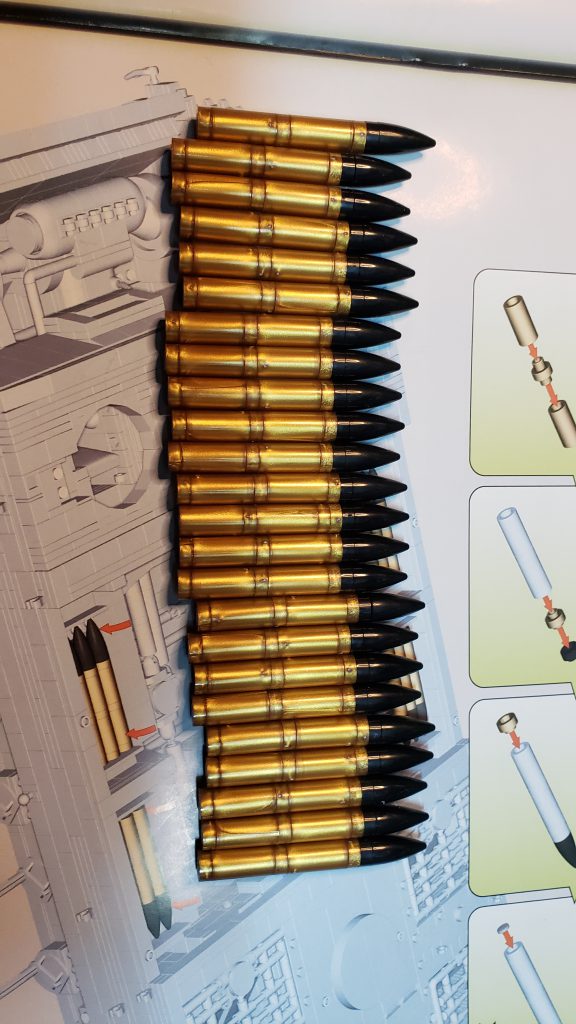
Before the deck goes in we build the 8.8 ammunition for the gun.

Loading up the storage compartments.

The deck cover is now in place and so endeth this phase.

Back from vacation it will be time for the wheels. Keeping it rolling. (Oh look another foot!)
Previous Build
USS Arizona BB-39

This was a 2 in 1 as you could also build it as the USS Pennsylvania.
USS Arizona was a battleship built for the United States Navy in the mid-1910s. Named in honor of the 48th state, she was the second and last ship in the Pennsylvania class. After being commissioned in 1916, Arizona remained stateside during World War I but escorted President Woodrow Wilson to the subsequent Paris Peace Conference. The ship was deployed abroad again in 1919 to represent American interests during the Greco-Turkish War. Two years later, she was transferred to the Pacific Fleet, under which the ship would remain for the rest of her career.
The 1920s and 1930s saw Arizona regularly deployed for training exercises, including the annual fleet problems, excluding a comprehensive modernization between 1929 and 1931. The ship supported relief efforts in the wake of a 1933 earthquake near Long Beach, California, and was later filmed for a role in the 1934 James Cagney film Here Comes the Navy before budget cuts led to significant periods in port from 1936 to 1938. In April 1940, the Pacific Fleet’s home port was moved from California to Pearl Harbor, Hawaii, as a deterrent to Japanese imperialism.
On 7 December 1941, the Japanese attacked Pearl Harbor, and Arizona was hit by several air-dropped armor-piercing bombs. One detonated an explosive-filled magazine, sinking the battleship and killing 1,177 of its officers and crewmen. Unlike many of the other ships attacked that day, Arizona was so irreparably damaged that it was not repaired for service in World War II. The shipwreck still lies at the bottom of Pearl Harbor beneath the USS Arizona Memorial. Dedicated to all those who died during the attack, the memorial is built across the ship’s remains.
This got me to thinking…Martha Stewart is kinda hot.
You’re building a Tiger I tank.
I’ve built them in 1/35 and 1/25 scale.
Would know those lines anywhere.
i was gonna just guess legos… but i think stretch may be right.
Thankfully, it’s not LIGOs.
“you’re a colliding black hole.”
(said in kip’s “your mom goes to college” parlance and intonations)
From the dim recesses of my memory, I seem to remember reading how the Soviets were the ones who instituted sloping armor, turning a few inches of steel into the equivalent of multiples of that. The Germans copied that idea, after initially having boxlike outlines that relied on just the bare thickness of the armor.
The soviets realized that what mattered was the thickness of armor along the penetration path, not the thickness at 90 degrees to the panel. AP rounds tend to travel close to parallel to the ground. So hitting an armor panel that’s vertical with a round that’s 10 degrees off from horizontal means the penetration path is almost as short as it can be. But hitting the same panel that’s at 45 degrees from the ground gives a penetration path that’s about 70% longer. Sloped armor also increased the chance of a ricochet compared to vertical panels.
He’s missing a big Toenail…