

The Three Doctors
Season Ten of Doctor Who, the classic series before the recent resurrection of the series, featured something that must have been a delight to fans of the show: William Hartnell, Patrick Troughton, and Jon Pertwee all appearing together.
Well, “together” isn’t exactly right. Let me explain.
Season Ten, consisting of 26 episodes comprising five serials, began with an attack on time itself. And, the plot line called for the Time Lords not being able to spare resources to help The Doctor. So, they sent The Doctor. And when The Doctor and The Doctor didn’t get along, they called on The Doctor to help.
I don’t think I explained that very well. Except that’s exactly what happened. Through some Time Lord mumbo jumbo, they managed to pull the Second Doctor (Patrick Troughton) into the time stream of the Third Doctor (Jon Pertwee), so they could combine forces and battle Omega, who’s a Time Lord gone mad. Or rogue. There seems to be a lot of them.
Anyway, The Doctor (3.0) and The Doctor (2.0) don’t get along, so they bring The Doctor (1.0) to keep them in line. After all, he was the mature one. He wasn’t impressed with his third or second incarnations, calling them “a dandy and a clown.” Due to William Hartnell’s health, he was only able to appear in studio, communicating via video screen with the other Doctors. Regardless, it was great to see William Hartnell in action again.
Hartnell’s appearances in the serial were his last role of any kind, not just in Doctor Who. The episodes were filmed in late 1972, and aired beginning just before New Year’s, and ran into late January 1973. Hartnell’s health continued to decline, and he was hospitalized in December 1974, and died in April of 1975.
At the end of The Three Doctors (4 episodes), the Time Lords removed the sentence of exile from The Doctor, allowing him to use the TARDIS as before. He made some trips with Jo, but returned to Earth, no longer unable to control the TARDIS. He did experience some issues with landing where he expected, but it wasn’t the completely lost in time and space situation from the first six seasons.

Being a Time Lord can sometimes be a drag.
The Master returned in Frontier in Space (6 episodes). It was Roger Delgado’s last appearance on Doctor Who. He died around three months after the episode aired while filming a movie in Turkey. Pertwee and Delgado were close friends, and Delgado’s death was one of the reasons that contributed to Pertwee’s decision to leave the role of The Doctor after the next season.
The Daleks returned at the end of that serial, and followed as the primary antagonist in the next serial, Planet of the Daleks (6 episodes). That serial was could be considered a sequel to Season One’s The Daleks, the second Doctor Who serial, and the one that introduced those characters. In Planet of the Daleks, The Doctor encounters Thals, who are still battling the Daleks after all these years.
The season ended with the departure of companion Jo Grant (Katy Manning) after she married a hippie environmentalist professor. The serial, The Green Death (6 episodes) was a typical 1970s environmentalist piece. It was typical leftist promotion, with a giant chemical company actively working to poison the planet. The episode also featured a scene of The Doctor in drag. Those wacky Brits.
I’ve enjoyed Jon Pertwee’s time as The Doctor, especially since he’s able to cross time and space again. He had one more season in the role before turning it over to Tom Baker. I’m looking forward to seeing Pertwee’s last season. Not to say farewell to him, but to see him as The Doctor some more. As long as he’s in space and not doing more left-wing hippie stuff.
 Season Nine of the classic Doctor Who series — I’m watching them all from the 1963 beginning — featured the return of the Daleks. And, as always, they want to exterminate, exterminate, EXTERMINATE! The season consisted of five serials, made up of 26 episodes.
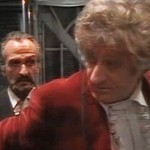 The eighth season of Doctor Who featured the return of the Autons, first seen in Season Seven’s Spearhead from Space. It also introduced Jo Grant (Katy Manning) as The Doctor’s new assistant, replacing Liz Shaw (Caroline John) who was mentioned as having left for Cambridge. Also introduced, or maybe re-introduced, was The Master (Roger Delgado), a renegade Time Lord.
 . Yes, I know Stephen King published Under the Dome in 2009, but he it’s a rewrite of an unfinished story from 1972. It’s obvious The Doctor took the TARDIS forward in time from 1971 (when this episode first aired) and stole the idea from King. He should sue.
 .
. The seventh season of Doctor Who (the original run, not the 2005 series) was in color. That’s about the only extra expense they put into the show. The special effects are pretty much on par with the first six seasons. That is to say, it’s 1960s British television. Only, it’s not. It’s 1970s British television, since Season Seven premiered in 1970.
 except that the bad guys had less facial hair.

 I’m watching the original Doctor Who episodes. I forget why, but now that I’ve started, I don’t think I can stop. I’ve now watched six seasons, covering two incarnations of The Doctor. William Hartnell originated the role, but left the series early in Season Four. Patrick Troughton took over the role, and remained through Season Six. He left, and a new actor, Jon Pertwee takes over in Season Seven. More about the Troughton to Pertwee transition in a bit.

 The fifth season of Doctor Who saw another cast change, as well as a few recent discoveries. Two recently discovered serials (or nearly-complete serials) were released on home video in 2013. The season featured two battles against the Cybermen, and two against robot yetis. More on all that in just a bit.
 The Classic Doctor Who fourth season was, as the third, difficult to watch. Part of it was the storylines, particularly early in the season, but most of the problem is that most of the episoded don’t exist. None of the serials are complete.
 Watching the original Doctor Who series from the beginning is a very strange experience. I’ve not seen the new show (the 2005 revival), and, as I mentioned before, I only had previously seen some Tom Baker (mostly) and Peter Davison (very few) episodes on PBS back in the ’70s and ’80s.
 did a better job with it. They got it all wrong, from the reason for the gunfight, to the participants, to who was killed, to … well, they got it all wrong.
 My venture into the world of Doctor Who (
 starring Peter Cushing (the
 I
I  recently.
 (the 2005 version). I was all caught up on everything else, and said “Hey, what the heck.” And, I liked it. Got weird at the end. Jimi Hendrix weird. Overall, though, I liked it.
 is. So, maybe I’ll watch that, I thought.
 silly. Just silly.
 won Best Picture. Now, I could just watch that and meet my goal. But that’s the slacker way of doing things. No, I had to watch the first two movies in the trilogy first. And I hated each and every minute of it. Yes, I know, a lot of people — good people — love those movies. But not me.