
{Oppo squints his eyes, trying to figure out if they’re just making things up . . . }
Quantum Spacetime on a Quantum Simulator
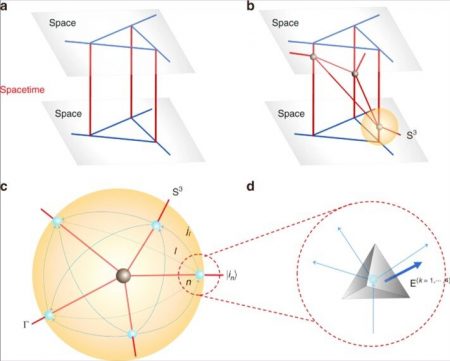
Phys.org / October 18, 2019 / Thamarasee JeewandaraIn a recent study, Keren Li and an interdisciplinary research team at the Center for Quantum Computing, Quantum Science and Engineering and the Department of Physics and Astronomy in China, U.S., Germany and Canada, experimentally simulated spin-network states by simulating quantum spacetime tetrahedra on a four-qubit nuclear magnetic resonance (NMR) quantum simulator.
The experimental fidelity was above 95 percent.
“Ah, that sounds pretty good. . . I was just going to ask about that. That’s what I would’ve gone for.”
{Oppo looks nervously around for somewhere to refill his drink.}
The research team used the quantum tetrahedra prepared by nuclear magnetic resonance to simulate a two-dimensional (2-D) spinfoam vertex (model) amplitude, and display local dynamics of quantum spacetime.
. . .
The team modeled the boundary of the enclosed quantum spacetime precisely as a spin network and showed the possibility of simulating large quantum spacetimes with many vertices by quantum gluing the atoms.
{Oppo, by the way, ends up driving this person home because they filled up their car with diesel instead of gasoline by mistake.}
Try it with a dodecahedron with a four-qubit NMR quantum simulator. Impossible? Says who?
C’mon they are just making sh*t up for grant money.
I think I understood half they words. But that was including the articles