IMAO Time Machine: IMAO Podcast #3 6-13-05

The 3rd IMAO Podcast, from 2005 — The Editors


  1. Introduction & sponsors (No gags in this week’s intro, so it was kinda dull. Skip to the 2 minute mark if you get bored.)
  2. “World of Knowledge” w/ host Frank J: How to box a chimpanzee
  3. Harvey: Fun Facts about Arizona Part 1
  4. Right Wing Duck with the Border Report
  5. Harvey: Fun Facts about Arizona Part 2
  6. SarahK reviews the entire Firefly series
  7. Right Wing Duck’s One Minute of Funny: John Kerry
  8. New Sponsor: Lakeside Psychiatry
  9. Spacemonkey & Right Wing Duck get paid by Frank
  10. Frank J & SarahK do some wedding planning
  11. Frank Discourse (Roundtable): the panel dissects Frank J’s phone call to the Rush Limbaugh show (Bob Geldoff, Live Aid, Dave Matthews, and Frank’s failure to pimp the blog)
  12. Frank: Conclusion, listener email

It’s Saturday. . . Want To Feel Exceedingly Dumb?

{Oppo squints his eyes, trying to figure out if they’re just making things up . . . }


Quantum Spacetime on a Quantum Simulator
Phys.org / October 18, 2019 / Thamarasee Jeewandara

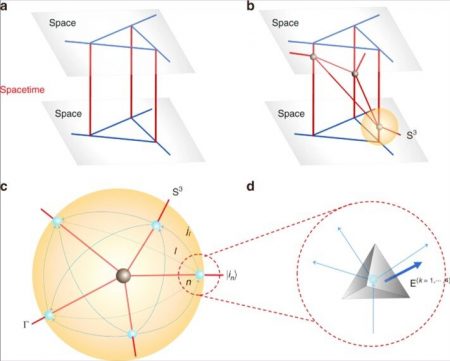
In a recent study, Keren Li and an interdisciplinary research team at the Center for Quantum Computing, Quantum Science and Engineering and the Department of Physics and Astronomy in China, U.S., Germany and Canada, experimentally simulated spin-network states by simulating quantum spacetime tetrahedra on a four-qubit nuclear magnetic resonance (NMR) quantum simulator.

The experimental fidelity was above 95 percent.

“Ah, that sounds pretty good. . . I was just going to ask about that. That’s what I would’ve gone for.”
{Oppo looks nervously around for somewhere to refill his drink.}

The research team used the quantum tetrahedra prepared by nuclear magnetic resonance to simulate a two-dimensional (2-D) spinfoam vertex (model) amplitude, and display local dynamics of quantum spacetime.

. . .

The team modeled the boundary of the enclosed quantum spacetime precisely as a spin network and showed the possibility of simulating large quantum spacetimes with many vertices by quantum gluing the atoms.

{Oppo, by the way, ends up driving this person home because they filled up their car with diesel instead of gasoline by mistake.}

NBA: Nothing But Athletes

I confess: the primary reason for this is that I just wanted an excuse to post this photo of NBA Commissioner Adam Silver, poster boy for corporate sports.

Yowza! I was going to make this a “Caption This Photo” contest, but without context it’s nothing:

NBA Commissioner: “We Certainly Didn’t Apologize To The Chinese Government”
Hotair | 10/17/2019 | John Sexton

Commissioner Adam Silver told TMZ Sports that’s he’s bothered so many people think the NBA knuckled under and apologized to China over Daryl Morey’s tweet supporting Hong Kong’s freedom.

The initial statement read, “We recognize that the views expressed by Houston Rockets General Manager Daryl Morey have deeply offended many of our friends and fans in China, which is regrettable.”

“While Daryl has made it clear that his tweet does not represent the Rockets or the NBA, the values of the league support individuals’ education themselves and sharing their views on matters important to them.” Silver explained to TMZ Sports … “It bothered me that in saying we regretted upsetting hundreds of millions of Chinese fans while at the same time supporting Daryl Morey’s speech, it bothered me, I’d say, that it was interpreted as an apology to the Chinese government.”

“We certainly didn’t apologize to the Chinese government.”

. . .

But the new version of reality being offered by Silver and Stern also fails to mention a couple of other things, starting with the fact that the NBA published two different versions of the statement, one in English and one in Mandarin for Chinese fans. As the Associated Press pointed out, the two statements were very different in tone.

. . .

Silver and Stern also fail to mention the apology to China by [Houston Rockets star] James Harden: “We apologize. You know, we love China. We love playing there.”


Cool Science

There’s no joke here.

Just some compelling science that will surely develop in the coming years — the wave of the future, perhaps.

For those of you with an aptitude for that kind of stuff —I’m looking at you, FrankJ.

Argonne [National Laboratory] Explores How Ants, Bees, and Fruit Flies Can Be the Next Big Buzz in Artificial Intelligence
Argonne National Laboratory | 12 Sept 2019 | Dave Bukey and Mary Fitzpatrick

Space. The final frontier.

And on Nov. 2, 2018, NASA’s Voyager 2 spacecraft crossed into the vastness of interstellar space, following Voyager 1, which made the leap six years earlier. Since their launch in 1977, the two probes have traveled more than 11 billion miles across the solar system, lasting much longer than scientists anticipated.

Powered by plutonium and drawing 400 watts of power each to run their electronics and heat, the probes still snap photos and send them back to NASA. After 42 years, though, only six of Voyager 2’s 10 instruments still work, and NASA scientists expect the probe will go dark in 2025, well before it leaves our Solar system.

But what if Voyager 2 needed only a couple of watts of power? Could it survive long enough to continue its explorations far into the future?

These are the types of questions that scientists are asking at the U.S. Department of Energy’s (DOE) Argonne National Laboratory. Here, Angel Yanguas-Gil, principal materials scientist in the Applied Materials division, is leading an interdisciplinary team that is rethinking the design of computer chips to not only perform and adapt better, but to do so using a minuscule amount of power — around one watt.

For inspiration, the team is looking to the brains of insects, such as ants, bees, and fruit flies — which offer a new frontier in a type of artificial intelligence known as neuromorphic computing. What they have found could turn artificial intelligence on its artificial head.

Inspired by biology, the team’s newly designed computer chips, which rely on new blueprints and materials, can bypass the “cloud” to learn on the fly, radically conserve power and adapt to extreme environments, such as deep space and radioactive areas — all while delivering reliable, accurate results.

The soft underbelly of artificial intelligence
. . .

How is artificial intelligence inflexible? The answer lies in how a popular form of AI, called a neural network, spots meaningful arrangements in data. Most neural networks, which uncover patterns and relationships in data without explicit programming, are static, designed for a specific task, such as recognizing images. Once a network learns that task, it can’t switch gears and start driving a car.

“The scene changes, the distribution of data is slightly different than before, and what you learned no longer applies,” explained Sandeep Madireddy, a computer scientist in Argonne’s Mathematics and Computer Science (MCS) division, who has joined Yanguas-Gil’s team.

Insects, on the other hand, are versatile and can solve problems in different ways, said Yanguas-Gil.

“In a biological system, the network can learn by itself and offers a much higher degree of flexibility,” he said. “Evolutionary pressure on insects produces very efficient, adaptive computing machines. Bees, for instance, exhibit half the number of distinct cognitive behaviors of dolphins, just in a much smaller volume.”

Accurate under pressure
To prove this point, Yanguas-Gil and Argonne chemists Jeff Elam and Anil Mane designed and simulated a new neuromorphic chip inspired by the tiny brain structure of bees, fruit flies and ants. The team created a network from scratch that contains two pivotal discoveries:

• Dynamic filters and weights that change the strength of various neural connections, depending on what the system finds important in real time.
• Tungsten‐aluminum oxide, an award-winning nanocomposite material created by Elam and Mane, which would allow the chip to operate at power levels far below one watt. (By contrast, graphics processing units [GPUs], based on conventional silicon semiconductor processing, can consume 100 watts or more per chip.)

Testing of the new chip design revealed that it was as accurate as the standard design, but it learned much more quickly and retained its accuracy — even under 60 percent error rates in its internal operation.

“With neural networks, error rates of 20 percent erode the system’s accuracy,” said Yanguas-Gil. “Our system can tolerate much higher error rates and sustain the same accuracy as a perfect system. This makes it a good candidate for machines that spend 30 years in space.”

Future Headlines

Feel free to come up with a probable headline of your own…


Fastest-Healing Mouse in All Mexico Predicts Speedy Recovery

Halloween Etiquette: Can’t Say Boo
Founder of Wuss Nation Says Use of the Word “Boo!” Is Wuss-Phobic
Millions Point Out the Oxymoron


Cut and Pastiche

From the UK’s Independent (10/19/17):

North Korea Threatens “Unimaginable” Strike on U.S. After Military Drills

North Korea has threatened to launch an “unimaginable” strike on the US, accusing the Trump administration and its South Korean “puppet” allies of seeking to “ignite a war on the Korean peninsula at any cost”.

The statement released by the Korean Central News Agency, Pyongyang’s official’s mouthpiece, predicted “imminent catastrophic disaster” in the region.

Using typically hyperbolic language, it vowed to “mercilessly smash the war frenzy of the US and South Korean puppet warmongers to get rid of the abyss of ruin through dangerous war gambling and inflict the most miserable death on the invaders.”

North Korea’s statement added: “The US is running amuck by introducing under our nose the targets we have set as primary ones.”

“The US should expect that it would face unimaginable strike at an unimaginable time.”

. . . and, in related news:

Democrats Threaten “Unimaginable” Strike on Trump After Intelligence Agency Spying

Democrats have threatened to launch an “unimaginable” strike on US president Donald Trump, accusing the Trump administration and its Republican “puppet” allies of seeking to “ignite a war on American soil at any cost”.

The statement released by CNN, the Democrat official’s mouthpiece, predicted “imminent catastrophic disaster” in the nation.

Using typically hyperbolic language, it vowed to “mercilessly smash the non-war frenzy of the president and Republican puppet non-warmongers to get rid of the abyss of ruin through dangerous war gambling and inflict the most miserable death on the climate deniers.”

The Democrat/CNN statement added: “Trump is running amuck by introducing under our nose the targets we have set as primary ones.”

“Deplorables should expect that they would face imaginable strikes at a pretty imaginable time.”

Surrender of Cornwallis

Gen. Charles O’Hara surrendering to Gen. Benjamin Lincoln.

The Revolutionary War didn’t officially end until the Treaty of Paris in 1783, but the war effectively ended on October 19, 1781 with the surrender of British forces led by their general, The Earl Cornwallis.

Cornwallis signed the surrender document, but didn’t attend the surrender ceremony. General Charles O’Hara tried to surrender to French general Jean-Baptiste Donatien de Vimeur, the Count of Rochambeau, but Rochambeau pointed him to Gen. Washington, who in turn pointed him to his second-in-command, Gen. Benjamin Lincoln.

Washington’s troops had over 7,000 prisoners to deal with, partly because the rescue Cornwallis was wishing for eventually arrived, but left after seeing all the French ships there. Everything eventually worked out, though.

This is a great day in U.S. History. The Revolution was won.