
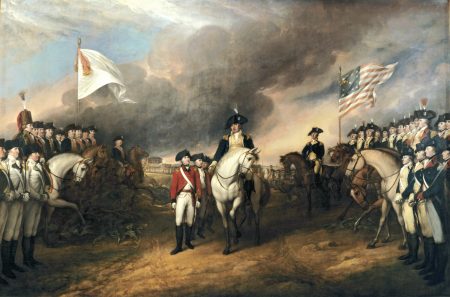
Gen. Charles O’Hara surrendering to Gen. Benjamin Lincoln.
The Revolutionary War didn’t officially end until the Treaty of Paris in 1783, but the war effectively ended on October 19, 1781 with the surrender of British forces led by their general, The Earl Cornwallis.
Cornwallis signed the surrender document, but didn’t attend the surrender ceremony. General Charles O’Hara tried to surrender to French general Jean-Baptiste Donatien de Vimeur, the Count of Rochambeau, but Rochambeau pointed him to Gen. Washington, who in turn pointed him to his second-in-command, Gen. Benjamin Lincoln.
Washington’s troops had over 7,000 prisoners to deal with, partly because the rescue Cornwallis was wishing for eventually arrived, but left after seeing all the French ships there. Everything eventually worked out, though.
This is a great day in U.S. History. The Revolution was won.
That evening an eyewitness wrote in his journal:
— Page Smith, A New Age Now Begins
Thanks for the reminder, guys! I hate to admit it, but I needed it.