Tuesday Night Open Thread: Racists Who Literally Suck

Meeting the Threat of Racist 3 Month-Old Babies
American Thinker | 3 Mar, 2021 | Thomas Lifson

We can all sleep more soundly now that the Arizona Department of Education is protecting the nation from the threat of racist 3-month-old babies. Christopher Rufo of City Journal tells the story in a series of tweets.

The Arizona Department of Education has created an “equity” toolkit claiming that babies show the first signs of racism at three months old and that white children “remain strongly biased in favor of whiteness” by age five.

Do you have something you’d like to share? A link? A joke? Some words of wisdom? A topic to discuss? It’s our nightly Open Thread, and you have the floor.

So … Now All Our Problems Are Over … ?

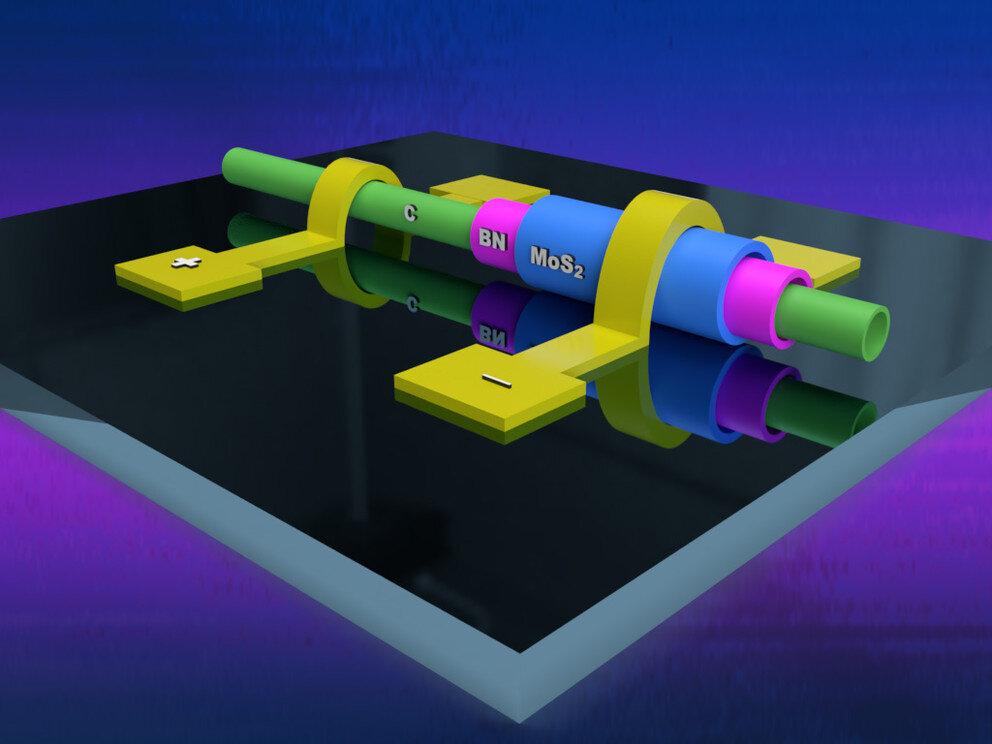
Image of a heterotube diode:

Sushi-Like Rolled 2D Heterostructures May Lead To New Miniaturized Electronics
Jamie Oberdick, Pennsylvania State University | Phys.org | 3/10/21

This device contains a MoS2 semiconductor shell (blue), over the insulator hBN shell (purple), over the carbon nanotube core (green) of the heteronanotube covered with gold electrodes (yellow). Credit: Elizabeth Flores-Gomez Murray/ Penn State.

Next step: getting it to stop making that “Pew! Pew! Pew!” sound.

Woo-Hoo! Humans Kick Total Ass. Yay For Real Science!

Tumors Illuminated Brightly and Precisely With New Biodegradable Nanoprobe

Caroline Brogan, Imperial College London | Phys.org | 3/11/21

To highlight tumors in the body for cancer diagnosis, doctors can use tiny optical probes (nanoprobes) that light up when they attach to tumors. These nanoprobes allow doctors to detect the location, shape and size of cancers in the body.

Most nanoprobes are fluorescent; they absorb light of a specific color, like blue, and then emit back light of a different color, like green.

However, as tissues of the human body can emit light as well, distinguishing the nanoprobe light from the background light can be tough and could lead to the wrong interpretation.

Now, researchers at Imperial College London have developed new nanoprobes, named bioharmonophores and patented at Imperial, which emit light with a new type of glowing technology known as second harmonic generation (SHG).

The findings are published in ACS Nano.

Bioharmonophores are both biocompatible and biodegradable as they are made of peptides—the same ingredients of proteins found in the body. They are metabolized naturally in the body within 48 hours and are therefore unlikely to pose long-term health risks.

Take that, cancer!

I pause in my celebration to notice that no reference was made in the article to the skin color or diversity of the researchers.