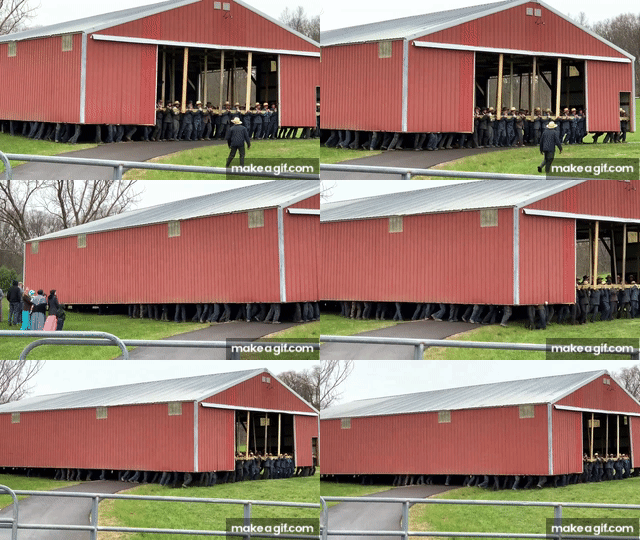
Mika uses a microphone as a poor Oppo substitute… And a cell phone as his fingers.

.
I’ve gotta seek help. She’s a lib. With good boobs.
Tech company headed by former CEO of bankrupt Solyndra to receive $6.6 billion from Biden admin
Just the News | 4/9/24 | Kevin KilloughA semiconductor company whose president was head of the now-bankrupt Solyndra solar energy company stands to receive $6.6 billion in funding from the Biden administration.
Under a preliminary agreement, according to CNBC, a subsidiary of Taiwan Semiconductor Manufacturing Co. (TSMC) in Arizona will receive the funding under the U.S. CHIPS and Science Act.
The company’s president is Brian Harrison.
The Washington Free Beacon reported that Harrison was CEO of Solyndra, which in the early 2000s was involved in the manufacturing of solar panels and considered at the forefront of the sustainable energy industry.
Excerpt from Wikipedia:
“The [taxpayer-funded] loan program took a $528 million loss from Solyndra.”
That’s in the neighborhood of 10% for the big guy.
The Obama administration had selected Solyndra as the first to receive a loan under an Energy Department program designed to provide government support to companies that would create jobs while generating energy from cleaner sources, such as solar, wind and nuclear. President Obama personally visited the Solyndra complex, hailing it as a leader in this emerging field.
In August [2011], though, Solyndra abruptly shut its doors, laying off 1,100 workers. Within days, it had declared bankruptcy. The House Energy and Commerce Committee’s investigative subcommittee has held two hearings intending to unwind the deal and understand how signs of Solyndra’s financial trouble had been overlooked by the Department of Energy.
In a few hundred years, the results of those hearings.
Plans. Plans, plans, plans. We finally got a chance to get into the house with our contractors for a short period of time. A lot of discussions and the result is we have a tentative plan of what we want done. Now comes the fun part, how much? We await the projected cost summary. That aside I have been planning out where all my furniture and belonging will go. So far it looks like everything will fit easily. That was helped by a fortuitous discovery. Doing the first walk throughs there was this door in the bedroom which we thought was a closet. Upon opening it looked like a blank wall about 3 inches in. Odd, but it was dark and I didn’t think about asking about it. When we did the walk through this week we took a closer look and discovered it wasn’t a wall but another door. When we unlocked the door and looked in we found 3 storage room/areas. While not tall, only about 5 and a half feet, they were still substaintial with one having clothes racks and shelving. All my storage needs met! It certainly helps clarify what I will now keep or get rid of. So that’s what I was building this week. Regular builds will probably resume in May after I move in. Until then, here is a previous build.

PzKpfw. V Panther Ausf. G
The Panther tank, officially Panzerkampfwagen V Panther (abbreviated PzKpfw V) with ordnance inventory designation: Sd.Kfz. 171, is a German medium tank of World War II. It was used on the Eastern and Western Fronts from mid-1943 to the end of the war in May 1945.
On 27 February 1944 it was redesignated to just PzKpfw Panther, as Hitler ordered that the Roman numeral “V” be deleted. In contemporary English-language reports it is sometimes referred to as the “Mark V”.
The Panther was intended to counter the Soviet T-34 medium tank and to replace the Panzer III and Panzer IV. Nevertheless, it served alongside the Panzer IV and the heavier Tiger I until the end of the war. The Panther was a compromise. While having essentially the same Maybach V12 petrol (690 hp) engine as the Tiger I, it had better gun penetration, was lighter and faster, and could traverse rough terrain better than the Tiger I. The trade-off was weaker side armour, which made it vulnerable to flanking fire, and a weaker high explosive shell. The Panther proved to be effective in open country and long-range engagements. Although it had excellent firepower, protection and mobility, its reliability was less impressive. The Panther was far cheaper to produce than the Tiger I. Key elements of the Panther design, such as its armour, transmission, and final drive, were simplifications made to improve production rates and address raw material shortages. Despite this, the overall design has still been described by some as “overengineered”.
The Panther was rushed into combat at the Battle of Kursk in the summer of 1943 despite numerous unresolved technical problems, leading to high losses due to mechanical failure. Most design flaws were rectified by late 1943 and early 1944, though the bombing of production plants, increasing shortages of high-quality alloys for critical components, shortage of fuel and training space, and the declining quality of crews all impacted the tank’s effectiveness. Though officially classified as a medium tank, at 44.8 metric tons the Panther was closer in weight to contemporary foreign heavy tanks. The Panther’s weight caused logistical problems, such as an inability to cross certain bridges, otherwise the tank had a very high power-to-weight ratio which made it highly mobile.
The naming of Panther production variants did not, unlike most German tanks, follow alphabetical order: the initial variant, Panther “D” (Ausf. D), was followed by “A” and “G” variants.
The Panzer V Ausf. G (September 1943 – May 1945)
The Panzer V Panther tank was given the Ausf.G version designation to indicate this production run of tanks used a different redesigned chassis. The turret and 7.5cm Kw.K L/70 gun was the same one used on the earlier Ausf.A.
On 4 May 1944, during a meeting at the M.A.N. company, a decision was made to design a new Panther tank chassis. Work had already started on developing a new version of the Panther tank called Panther II but that was far from completion. Some of the lessons learnt from that design process were used in formulating the plans for the Ausf.G tank chassis.
The side pannier armor that covered the top of the tracks on both sides of the tank was angled at 40 degrees on the Ausf.D and Ausf.A tank chassis. The new chassis pannier side armor was sloped at 29 degrees. The thickness in the armor was increased from 40 mm to 50 mm. This increased the weight of the tank by 305 Kg.
To compensate for this increase in weight the designers looked for areas where the thickness of the armor could be reduced. They chose to use 50 mm armor plate on the lower front hull instead of the normal 60 mm. This saved 150 kg. The forward belly plates were reduced to 25 mm from 30 mm. The front two belly plates were 25 mm thick and the rear plate was 16 mm thick. This saved a further 100 kg in weight. The rear side armor wedges at the end of the superstructure were not part of the new design. The floor of the pannier was now a straight line. These weight reduction changes meant that the increase in side armor thickness did not result in an increase in weight of the Ausf.G tank chassis compared with the older chassis.
As the bottom of the pannier was now 50 mm nearer to the top of the track no weld seams or stowage straps were fixed there. This was to stop them coming into contact with the track as the tank drove fast over undulating ground. Instead the stowage straps were welded to the side of the pannier armor.
There were many other minor changes but the overall thinking behind the design was to simplify the construction process to enable more tanks to be built as fast as possible. For example, the ventilation systems for the transmission, brakes, engine and exhaust were redesigned. This meant that the two additional parallel vertical pipes that came out of the left armoured exhaust cover at the rear of the tank on the late production Ausf.A tank chassis were no longer needed. Starting in May 1944, cast armor exhaust guards gradually replaced welded ones. To help reduce the red glow given off by the exhaust pipes at night, as a temporary solution, sheet metal covers were gradually introduced starting in June 1944. Starting in October 1944 these were replaced gradually with purpose build Flammenvernichter flame suppressor exhaust mufflers. When additional supplies became available they were back-fitted to other Panther tanks.
Another simplification of the production process was to introduce less complicated hinged hatches above the heads of the driver and radio operator. It was found during trials that the performance of the cross-country ride of the tank with or without the rear shock absorber was practically the same. Starting from 7 October 1944 the factories were ordered to stop fitting them to help simplify production.
Maschinenfabrik-Augsburg-Nuernberg (M.A.N.) started producing Panzer V Ausf.G Panther tanks from Fahrgestell-Nummer Serie chassis number 120301: Daimler-Benz from chassis number 124301 and Maschinenfabrik Neidersachsen Hannover (M.N.H.) from chassis number 128301.
Buttigieg Downplays D.C. Crime Rate, Says He Can ‘Safely Walk’ His Dog
Breitbart | 04/09/2024Secretary of Transportation Pete Buttigieg dismissed the idea that Washington, DC, is experiencing a rise in crime, pointing out that a “lot of energy” was going into painting the narrative.
[Like, all those news stations and newspapers…]
During an interview with MSNBC host Jen Psaki on Sunday, Buttigieg highlighted how he was able to “safely walk” his dog in the nation’s capital without any problems. Buttigieg, like many other elected officials, is provided with a security detail.
Naked man ‘took advantage of Planet Fitness transgender locker room policy’ to parade his genitalia in ladies’ locker room and ask women to ‘shower with him then rub lotion on his back’
Daily Mail | 4/11/24A naked man reportedly took advantage of Planet Fitness’s transgender locker room policy to parade his genitalia around the ladies’ facilities and be inappropriate towards women.
… The gym’s policy allows members to use whichever bathroom and locker room that aligns with the gender they identify [with] as part of the no-judgement motto.
“Fitness Chain Makes Judgement in No-Judgement Case”
Does it really count as a parade? Maybe if there were 76 throbbing bones …

“Miss Munro? Nice surprise but where is Miss Cates?”
“No one knows sir, she just did not show up today.”
“That’s not like her. Is anything being done?”
“We have organized search parties and have alerted the appropriate authorities.”
“I hope she returns shortly and is all right.”
“We all do sir. Here is what was in her last files.”