
|
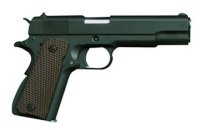
I finally have to ask: Am I wrong and the world right, or is there never a reason to manually cock a 1911?
I see it all the time in movies and TV and even recently saw it in a comic book (The Watchmen — not a light afternoon read); people draw a 1911 and then cock it (the novel Cryptonomicon even had someone removing the safety and then chambering a round on a 1911 which I won’t even get into how ridiculous that sequence that is). As I understand, you should never have the hammer down on a 1911 with a round in the chamber. Also, decocking a 1911 is awkward and should probably never be done with a round in the chamber (I have to use two hands to do it; one to hold down the grip safety and squeeze the trigger and the other to thumb the hammer). You either carry the 1911 with no round in the chamber or you carry with it cocked and safety engaged (and you can only engage the safety if the gun is cocked). Or you leave it at home.
Am I wrong?
Frank,
The M-1911 (.45 cal ACP) has THREE safeties. One is the manual safety on the left rear of the body of the weapon. The next is the hand grip safety. The third is the half cocked position of the hammer. It is, when trouble is expected in the very, very near future (as in combat), OK to keep the weapon on half cock with a round in the chamber.
The .45 is a very sweet round as opposed to the 9mm which has a tendency to irritate one’s opponent. I had one of my soldiers survive a burst of eleven 9mm rounds. He likely would not have survive ONE .45 hit.
Kimber probably makes the best .45 M-1911 reproduction on the planet. I own one and would not trade it for any other handgun.
GVA
you are correct. I have been competing with 1911’s for over 20 years. I carry cocked and locked and leave hammer down on empty chamber when not in my holster.Safety is between your ears it is not a lever on a gun!
My Dad had a 1911 that had another safety. If there was any pressure on the muzzle, it wouldn’t fire. He said that was to keep you from pushing the gun into some ones back. I don’t know if that was standard for the gun, or a modification. He was a Marine, and then a Cop, and had friends who were gunsmiths, so it’s hard to tell where he got it.
DUDE. Take it from me- you NEVER, EVER attempt to manually cock a 1911 or clone except in an emergency. You could basically lose the use of your thumb if you blow it and you ND. To bring the firearm into firing condition, you point the muzzle in a SAFE direction and rack the slide. The only thing dumber than thumb-cocking is a “press check,” also known as the Frodo check- as in Frodo of the 9 fingers, if you recall your Tolkien. You must remember the doctrine that ALL guns are ALWAYS loaded. During thumb-cocking, the muzzle will typically swing wildly as you attempt to shift your grip and cock the hammer. Of course, I’m only the guy who helped set up dual firearms instructor certification in New York, a RSO, a graduate of the Lethal Force Institute and a firearms competitor, so what do I know compared to the guys who do movies and TV, right?
You are correct Viking. This is common to all 1911’s. It’s the nature of the lock-up and action. If you push on the muzzle, you will note the chamber area drop down. Think about that swing link in there. That’s your first clue.
I actually cringe when I see it happen. But heck, I’ve seen them thumb-cock Walther P99s on TV and in movies, too, and the hammer’s hidden inside the gun and everything!
The phenomenon of people manually cocking 1911’s with loaded chambers is simply a form of natural selection. It’s one of nature’s ways of weeding fools and losers out of the gene pool.
The muzzle safety, as I understand it, was so you could have the weapon cocked and ready to go off, press it against the back of a prisoner, and take him in. If he tries to run, the safety disengages and the prisoner dies.
The muzzle safety, as I understand it, was so you could have the weapon cocked and ready to go off, press it against the back of a prisoner, and take him in. If he tries to run, the safety disengages and the prisoner dies.
I thought that that wasn’t a safety, but just an artifact of how that particular semi-auto works, i.e., it’s a bug, not a feature. I think there are other semi-autos that don’t work with pressure on the concealed barrel.
In which case, Frank, the WW2 vets I talked to just took advantage of the “artifact” to scare the bejeezus out of their prisoners on Saipan.
The whole point of cocking a government model is this: It looks and sounds cool. That’s all hollywood cares about.
Similarlyi, all Hollywood military explosives are huge, slow-moving fireballs, and grenades have either a 1-second fuze or a 15-second fuze, the longer one if the hero has to escape.
don’t forget, below the equator use banana oil on the slide in alaska high grade blubber oil mixed with lighter fluid works fine..
I worked the West Side of Chicago in the ’70’s & always carried it with one in the chamber – hammer down. When I needed it was ready to rock & roll. On the street you have no time to jack the slide. The s***heads know you carry it chambered & when they hear you cock it they hold their collctive breaths until they hear the safety click on. The .45 calibler is the best possible weapon for police work. I carried Speer hollow points. You hit a guy in the shoulder you take it off & he indeed stops with one shot. A hellava weapon. Just as good as it was in 1911. I’ll take it every time, hands down, over a 9 mm.
Who Watches the Watchmen?
Definitely not a light read. I enjoyed it immensely, though I’m curious how well the story will translate onto the big screen.
/If Michael Madsen isn’t the Comedian, the casting director needs shot.
The 1911 was designed for carrying hammer cocked, one in the chamber, saftey on.
It’s so kewl when someone holds a person at “gunpoint” with a 1911 with the hammer down. Even kewler to hold the gun sideways. Or Upside Down! Of course if the person on the other end of the 1911 has a little sense, they will break the guys fingers taking the gun away and then break whatever else they want.
The 1911 was DESIGNED to be carried locked and LOADED. There is NO ADVANTAGE to carrying with a round in the chamber and the hammer down. It may scare the soccer moms and children a little less but who cares?
As has already been said, the third safety feature on many pistols is the “half-bent” hammer position. Depending on your personal preference, or the policy of your department, the weapon could be carried with a round chambered and the hammer in the half-bent position. What REALLY annoy me is seeing movies where someone racks the slide, points the weapon, and then 10 seconds later cocks the hammer. Shouldn’t have to explain why THAT one is ridiculous.
As for the barrel-lock feature, it’s also present on many other pistols. I once saw a cop have his life spared by the fact that the man who had just disarmed him had pressed the barrel of the gun into him before repeatedly pulling the trigger. Not sure if it’s a bug or a feature, but I do know that this cop was damn happy it existed.
“I worked the West Side of Chicago in the ’70’s & always carried it with one in the chamber – hammer down. When I needed it was ready to rock & roll. On the street you have no time to jack the slide.”
I invite everyone to read the above comment out loud with the theme from Shaft playing in the background. The theme from Truck Turner will do in a pinch.
My 1911 gets carried with an empty chamber because having an assailant laugh himself to death because I shot myself in the foot isn’t as efficient as pulling the slide back and shooting the bastard. I need that foot too.
Up until fairly recently many departments required a hammer down position for officers wearing 1911s. I had a partner that carried John Browning’s shootin’ iron and it was a regular thing for somebody to tell him (with a quaver of abject fear in their voice, that his gun was cocked.
The best thing to come along in years for 1911 afcionados is the holster with a thumb snap that goes under the hammer, it takes away the possibility of the thumb safety being moved to off accidentally.
Condition 2 carry? Blaaaaaaaaaaaah.
Been wearing a 1911 for the better part of 30 years, still can’t come up with a reason for doing it. The only person I ever heard defend the practice cut his teeth on a Single Action Army and couldn’t get away from the idea of cocking while drawing. FWIW, the 1911 (not A1 ) has a wide, checkered hammer spur, so maybe there was something to it back among the old “horse soldiers” who were issued the newfangled self-loader.
In case you’re wondering how the Army wanted you to shoot a 1911 while mounted, start at Page 66:
http://www.sightm1911.com/manual/manual.htm
Cocked and locked is the only way anyone should carry a semi-auto. If someone is charging you with a knife, or if (as is fairly common in SD moments) you are being subjected to a beating or having to use your hand to keep a man at bay, how are you going to rack the slide?
Folks who carry on an empty chamber are carrying something between a firearm and a club
It’s so fun to read comments from M1911A1 owners… who all know their stuff.
Albo said it, cocking a .45 (really, all the handguns in movies and TV) is just show biz.
I carry my .45 in condition one, all the time.
Oh, and I’ve had dinner with Mr. and Mrs. Frank J, and they were delightful company.
Round in the chamber, & NO S.A.F.E.T.Y. thank you very much. Someone attacks you out of the blue, you’re freaking out. Adrenaline. No control on your thumb to flick that 1911 safety. Get a DA/SA or a DAO, and enjoy grandpa’s 1911 at the range. I do. Got a mint condition 1911 issued in 1918 to the US army, and a 1926 commercial model very used and throated for hollowpoints. Carry a P229, Sig
Sauer, in .357 SIG, 12 in the magazine, one in the hole, with a mix of CorBon and frangibles. It goes Boom when you pull the trigger, every time.
Yes, that’s what real people do with .45 autos, all right.
The barrel safety is because of how the automatic mechanism works. If the barrel is not full forward, and the cartridge were to fire, gas could come out the back of the barrel, leading at best to a weak round, at worst to damage to the weapon and/or a bullet in the barrel.
Man. You guys are awesome. I always love hearing about how a guy can survive 11 hits with a 9mm but will die instantly to a single .45 hit.
I think 1911 awareness should be raised among traitors…after due process of course.
One way to require cocking a 1911 before firing is to put it into half cock. Half cock is acheived by putting your thumb on the hammer, pulling the trigger, letting the hammer go forward a hair, releasing the trigger, and gently setting the hammer on the sear. Not impossible to do, but dangerous because if the hammer slips out from under your thumb with the trigger pulled, you’re going to fire the gun. Also, with the hammer sitting on the sear, you’re adding a load it wasn’t designed to take (over the long term – it’s a safety designed to catch the hammer, not hold the hammer) and if it breaks, you fire the gun (likely in your holster).
You might also be able to set it all the way down starting with the above, but hold the trigger while you set the hammer (very gently) all the way down. DO NOT DO THIS!!! You will at best be dangerously close to firing the gun and taking out your thumb. It might also disengage or bypass other safeties built into the gun (other people would know better than I).
The ‘only’ way to carry a 1911 is cocked with the safety on. Not having a round in the chamber is pointless (like said before – something between a club and a firearm). And it’s perfectly safe.
It won’t go off with the hammer down. The pin
is too short. You would have to climb up on the
roof of your house and drop it straight on the
end of the barrel. Kinda hard to do, but anything
“IS” possible. Condition “1” is kinda dicey.
Better make damn sure the grip safety works
perfect. A lot don’t. Get rid of those stupid
bobbed hammers. Get the one with the spur. Then
it thumb cocks real easy. De-cocking? Easy unless
your a bozo. Tip don’t rack the slide. Use the
slide “release”. Then it never jams if you got
it set up right. The only thing better than a 1911 is 2 1911’s. One for each hand. Learn to use
it left handed. Making “empty” beer cans dance
while shooting from the hip is good practice.
Another observation. Mr. browning made the
1911 with a hammer that was built for “thumb
cocking”. The “A1” botched that up.
The firing pin is gonna move if you drop it
just right, no matter if the hammer is on the
gun or on your coffee table.
Aside from action heros, almost no one has the reflexes to unholster any pistol then aim then shoot if ambushed by an assailent. Hammer down or cocked.
The weapon should be carried hammer DOWN. Anything else is asking for trouble.
Just my opinion. And my Drill’s. And the range cadre. ( US Army Military Police )
If you can’t safley cock / uncock your weapon with out a round going off, SELL IT. Seriously.
Personally, I don’t care how all you yahoos carry your 1911s. How does Fred Thompson carry his?
In all seriousness, though, my first handgun was a Browning Hi Power. Without getting into the whole 9mm vs .45ACP debate, it wasn’t long after I started carrying it that I went out and got a Glock23c. I had a couple of occasions in two different holsters when my safety was nudged to the “fire” position and I was left with a loaded gun with absolutely no safety in place.
I realize that, unlike the BHP, the grip safety of the 1911 would have prevented a ND while in the holster, but I have never bought into the idea that the first thing you have to do when you clear leather is to rack the slide. I just have never envisioned having that much time.
And in a world where there are tons of DA/SA and DAO guns out there, it’s just so easy to find a bit more safety in a gun caliber that begins with “4” (keeping in mind Rule 25). I’m all for shooting .45s, but for me, it’s only at the range.
However, the beauty of America is that YMMV, and it probably will.
The handling of any firearm must be reduced to the safest and simplest manual of arms. With the 1911, if the weapon is going to be used for defense, in other words, this is the gun you’re going to have available to defend your life at a moment’s notice, then you mush carry it cocked and locked. By this I mean with a round in the chamber, the hammer fully cocked and the safety engaged. Carrying the weapon in any other way is foolish as when deadly danger presents itself, fine muscle control is among the first physical abilities impaired. You don’t want to have to worry about chambering rounds, cocking hammers, etc. If you’re going to carry it on your person, use a holster that indicates that you recognize the mechanical characteristics of the firearm, in other words, don’t buy a holster that would allow the safety to be disengaged without your knowledge. Of course, always practice strict muzzle control, and keep your trigger finger in register–pointed parallel to the barrel and in contact with the receiver–until you’re milliseconds from pulling the trigger. Frequently rotate magazines and unload any magazines your’re not carrying for immediate use. Never try to drop the hammer manually. To “decock” the weapon, remove the magazine, and with the muzzle pointed in a safe direction, trigger finger in register, briskly rack the slide to extract and eject the unfired round. Lock the slide fully back and manually and visually check the chamber and magazine well; release the slide into battery and pull the trigger.
If this weapon is not to be carried as a defensive gun, treat it as you would any other weapon reserved for non-defensive purposes. Oil it, case it and keep the magazines unloaded.
In other words, your 1911 should always be in one of two conditions:
(1) Safe and empty: slide closed, chamber empty, hammer down, no magazine in the magazine well.
(2) Cocked and locked: slide closed, hammer fully cocked, safety on, live round in the chamber, fully charged magazine in the magazine well.
If you keep your 1911 in these two conditions, you should be able to tell its current condition at a glance. Of course, one must always check for loaded/safe condition if there is the slightest doubt and before handling any apparently “safe” firearm.
The 1911 is no more or less safe than any modern firearm as long is one is familiar with it’s mechanics and practices safe carrying and handling techniques. Keep it simple.
Mike, have you ever actually owened/fired a
real 45? Sure don’t sound like it. As far as
operation, I can draw/cock hammer/shoot both
the “ears” on your little head without a scratch
on you. But you will be “earless”. My 45 will
be on my person. Where, I will not say. I might
part your hair too, if it looks messy. (-:
Mike, have you ever actually owened/fired a
real 45? Sure don’t sound like it. As far as
operation, I can draw/cock hammer/shoot both
the “ears” on your little head without a scratch
on you. But you will be “earless”. My 45 will
be on my person. Where, I will not say. I might
part your hair too, if it looks messy. (-:
Hey Will C. I carry hammer down. One in the pipe
If I gotta pull the stupid thing out, well.
230gr. hardball is going downrange.
While we’re on the topic, here’s a rundown of different 1911 carry Conditions, first exposited by Col. Jeff Cooper (now, one of The Old Ones.)
http://www.sightm1911.com/Care/1911_conditions.htm
Conditions 2 and 3 (hammer down on loaded and empty chamber, respectively) are of questionable value, though I seem to recall that Condition 3 was used by paratroopers on D-Day. Given all of the potential for snagging on gear and the fact that they were jumping out of perfectly good airplanes, it was probably the only thing that made any sense.
Condition 4 is of passing interest. The firearm is put up in the house, out of immediate reach of children and other miscreants, but otherwise readily available, such as on a mantle. All ammunition is locked away, with the exception of a loaded magazine carried on one’s person. I’d point out that this is an expedient for use when geegaws like trigger guard locks are impractical or unavailable or if two people have to rely on the same pistol.
WHEN I WAS IN THE INFANTRY, I HATED THAT WEAPON. MAYBE THE ONES WE HAD WERE WORN OUT BUT I COULDN’T HIT SHIT WITH IT. THE DAMNED BRASS WOULD EJECT EVERYWHERE INCLUDING HOTLY DOWN THE BACK OF MY BDU JACKET. I WAS VERY HAPPY TO GET MY FIRST BARETTA 9MM WHICH I SHOT EXPERT ON. THEY SHOULD HAVE MELTED THOSE 1911 45’S OF OURS DOWN, TURNED THEM INTO BOMBS, AND DROPPED THEM ON THE FACTORY THAT MADE THEM.
Mike and Moriarty made a lot of sense and seemed to answer the initial question. Coogzilla, your youthful testosterone is evident.
Condition 1. Always.
HKPistole has spoken.
Viking is not only correct, it is one of the stupidest errors you see out of Hollywood, where the barrel of a 1911 is pressed against an individual and fired-dumb Hollywood.
I have carried my 1911 for years in condition one. I had a buddy try to talk me out of it so I called Springfield and asked them. The gun smith told me they recommend carrying with an empty chamber, but he sounded like he was trying to avoid a lawsuit. I am sticking with condition one.
I’ve never liked the 9mm round, especially hardball. Give me a nice wide round, softnose or hollowpoint, for self-defense. The only thing better than .44 or .45 is a 12-gauge.
Mike has it right. If a cocked & locked 1911 is to scary for you, I suggest selling the gun and sending the proceeds to your favorite gun control organization so that they can do public service announcements on scary gun owners.
“The firing pin is gonna move if you drop it
just right, no matter if the hammer is on the
gun or on your coffee table.”
Ever hear of a Series 80? Many of the 1911 knock-offs scammed the Colt pre-to-Series 70 design, but with Colt-style Series 80s and 90s, that is about as likely to happen as the world-ending asteriod (then meteor, then meteorite). IIRC, Para uses the Series-80-style firing pin block. Some Kimber models and also the new S&W 1911 have their own firing pin block design.
FWIW, I’m still alive and I have gently been dropping the hammer on a chambered round for years. And I’ve been doing pinch checks for years, too (except on the guide rod models, of course) and I still have all my fingers.
But hey, it’s all up to you. If dropping the hammer on a chambered round has too high of a butt-pucker factor, you can always look into one of the plastic double-action wonder-nines.